Indium Phosphide (InP) Wafers, Size: 4”, Thickness: 625± 25 μm, Orientation: 100, Single Side Polished, EPI-Ready

Price range: $1,536.00 through $7,176.00
Select options This product has multiple variants. The options may be chosen on the product page
Indium Phosphide (InP) Wafers Size: 4”, Thickness: 625± 25 μm, Orientation: 100 Technical Properties: Size (inch)  4” Thickness (μm)  625±

Indium Phosphide (InP) Wafers, Size: 4”, Thickness: 625± 25 μm, Orientation: 111, Single Side Polished, EPI-Ready

Price range: $1,536.00 through $7,176.00
Select options This product has multiple variants. The options may be chosen on the product page
Indium Phosphide (InP) Wafers Size: 4”, Thickness: 625± 25 μm, Orientation: 111 Technical Properties: Size (inch)  4” Thickness (μm)  625±

Gallium Antimonide (GaSb) Wafers, Size: 4”, Thickness: 1000± 25 μm, Orientation: 100, EPI-Ready

Price range: $1,699.00 through $7,041.00
Select options This product has multiple variants. The options may be chosen on the product page
Gallium Antimonide (GaSb) Wafers Size: 4”, Thickness: 1000± 25 μm, Orientation: 111 Technical Properties: Quality  EPI-Ready Size (inch)  4” Thickness

Gallium Antimonide (GaSb) Wafers, Size: 4”, Thickness: 1000± 25 μm, Orientation: 111, EPI-Ready

Price range: $1,699.00 through $7,041.00
Select options This product has multiple variants. The options may be chosen on the product page
Gallium Antimonide (GaSb) Wafers Size: 4”, Thickness: 1000± 25 μm, Orientation: 111 Technical Properties: Quality  EPI-Ready Size (inch)  4” Thickness

Indium Phosphide (InP) Wafers, Size: 4”, Thickness: 625± 25 μm, Orientation: 100, Single Side Polished, EPI-Ready

Price range: $1,420.00 through $6,638.00
Select options This product has multiple variants. The options may be chosen on the product page
1 piece/1280  5 pieces/5980                            Please contact us for quotes on larger quantities !!!

Indium Phosphide (InP) Wafers

Size: 4'', Thickness: 625± 25 μm, Orientation: 100

Technical Properties:

Size (inch)  4”
Thickness (μm)  625± 25
Dopant  Sulphur (N type)
Polished  Single Side
Mobility (1.5-3.5)E3
Orientation  100
EPD  ≤5000
Growth method  VGF
OF Length  32.5±2
IF Length   18±1

Fields of Application for Indium Phosphide (InP)

Indium phosphide (InP) is a binary semiconductor composed of indium and phosphorus. Indium phosphide (InP) has started to be developed at the beginning of 1980s. Indium phosphide (InP) which used in a high power and high frequency electronics, has superior electron velocity. Indium phosphide (InP) has a direct bandgap by contrast with many semiconductors. This makes indium phosphide (InP) useful for optoelectronics and laser diodes. Indium phosphide (InP) is a crucial material for production of laser signals, determination and conversion of those signals back to electronic form. Indium Phopshide (InP) is a binary semiconductor composed of Indium (In) and Phosphorus (P), belonging to a group of materials commonly known as III-V Semiconductors. InP is used in high power and high-frequency electronics and boasts a superior electron velocity in comparison to more common semiconductors such as Silicon and Gallium Arsenide. Indium Phosphide has a face-centred cubic crystal structure almost identical to that of GaAs and most of the lll-V semiconductors. InP wafers must be prepared prior to device fabrication, all III-V wafers must be lapped to remove surface damage that occurs during the slicing process. Wafers are then Chemically Mechanically Polished/Plaranrized (CMP) for the final material removal stage allowing for the attainment of super-flat mirror like surfaces with a remaining roughness on an atomic scale. The wafer is then ready for device fabrication.
  • Indium phosphide (InP) is used in modulators.
  • Indium phosphide (InP) is used in photo-detectors.
  • Indium phosphide (InP) is used in LEDs.
  • Indium phosphide (InP) is used in fiber communications components.
  • Indium phosphide (InP) is used in semiconductor optical amplifiers.

Indium Phosphide (InP) Wafers, Size: 4”, Thickness: 625± 25 μm, Orientation: 111, Single Side Polished, EPI-Ready

Price range: $1,420.00 through $6,638.00
Select options This product has multiple variants. The options may be chosen on the product page
1 piece/1280  5 pieces/5980                            Please contact us for quotes on larger quantities !!!

Indium Phosphide (InP) Wafers

Size: 4'', Thickness: 625± 25 μm, Orientation: 111

Technical Properties:

Size (inch)  4”
Thickness (μm)  625± 25
Dopant  Sulphur (N type)
Polished  Single Side
Mobility (1.5-3.5)E3
Orientation  111
EPD  ≤5000
Growth method  VGF
OF Length  32.5±2
IF Length   18±1

Fields of Application for Indium Phosphide (InP)

Indium phosphide (InP) is a binary semiconductor composed of indium and phosphorus. Indium phosphide (InP) has started to be developed at the beginning of 1980s. Indium phosphide (InP) which used in a high power and high frequency electronics, has superior electron velocity. Indium phosphide (InP) has a direct bandgap by contrast with many semiconductors. This makes indium phosphide (InP) useful for optoelectronics and laser diodes. Indium phosphide (InP) is a crucial material for production of laser signals, determination and conversion of those signals back to electronic form. Indium Phopshide (InP) is a binary semiconductor composed of Indium (In) and Phosphorus (P), belonging to a group of materials commonly known as III-V Semiconductors. InP is used in high power and high-frequency electronics and boasts a superior electron velocity in comparison to more common semiconductors such as Silicon and Gallium Arsenide. Indium Phosphide has a face-centred cubic crystal structure almost identical to that of GaAs and most of the lll-V semiconductors. InP wafers must be prepared prior to device fabrication, all III-V wafers must be lapped to remove surface damage that occurs during the slicing process. Wafers are then Chemically Mechanically Polished/Plaranrized (CMP) for the final material removal stage allowing for the attainment of super-flat mirror like surfaces with a remaining roughness on an atomic scale. The wafer is then ready for device fabrication.
  • Indium phosphide (InP) is used in modulators.
  • Indium phosphide (InP) is used in photo-detectors.
  • Indium phosphide (InP) is used in LEDs.
  • Indium phosphide (InP) is used in fiber communications components.
  • Indium phosphide (InP) is used in semiconductor optical amplifiers.

Indium Arsenide (InAs) Wafers, Size: 3”, Thickness: 625± 25 μm, Orientation: 100, EPI-Ready

Price range: $1,209.00 through $5,702.00
Select options This product has multiple variants. The options may be chosen on the product page
Indium Arsenide (InAs) Wafers Size: 3”, Thickness: 625± 25 μm , Orientation: 100 Technical Properties: Quality  EPI-Ready Size (inch)  3” Thickness (μm)

Silicon on Insulator (SOI) Wafers, Size: 8”, Device Thickness: 600 nm, P type

Price range: $1,210.00 through $5,633.00
Select options This product has multiple variants. The options may be chosen on the product page
Silicon on Insulator (SOI) Wafers Size: 8”, Device Thickness: 600 nm, P type Technical Properties: Size (inch)  8” Thickness (μm)

Gallium Antimonide (GaSb) Wafers, Size: 4”, Thickness: 1000± 25 μm, Orientation: 100, EPI-Ready

Price range: $1,301.00 through $5,392.00
Select options This product has multiple variants. The options may be chosen on the product page
1 piece/1180 € 5 pieces/4890 €                           Please contact us for quotes on larger quantities !!!

Gallium Antimonide (GaSb) Wafers

Size: 4”, Thickness: 1000± 25 μm, Orientation: 111

Technical Properties:

Quality  EPI-Ready
Size (inch)  4”
Thickness (μm)  1000± 25
Polished  Single Side
Dopant  Tellurium ( N type )
Orientation  100
Mobility  2000-3500
EPD  ≤2000
Growth method  VGF
OF Length  32.5±2
IF Length   18±1

Fields of Application for Gallium Antimonide (GaSb)

The intermetallic compound of gallium antimonide (GaSb) was first prepared in 1926 by Victor Goldschmidt. Gallium antimonide (GaSb) is a semiconductor made of gallium and antimony of the group III-V compounds. Gallium antimonide (GaSb) is supplied in polished wafer form. Gallium antimonide (GaSb) wafers are produced from polycrystalline ingots with using Czochralski method to obtain a single crystal with perfect purity. Supplied in polished wafer form, gallium antimonide has a very high accuracy of orientation. Thickness and orientation of these wafers can be modified with additives. Czochralski method is used to provide the growh of pure gallium and antimonide elements. The natural low-defect structure of GaSb makes it a perfect material for epitaxial growth. They are supplied in polished 1 side or 2 sides and cut forms.
  • Gallium antimonide (GaSb) is used for infrared detectors.
  • Gallium antimonide (GaSb) is used for infrared LEDs.
  • Gallium antimonide (GaSb) is used for transistors.
  • Gallium antimonide (GaSb) is used for lasers.
  • Gallium antimonide (GaSb) is used for thermophotovoltaic systems.

Gallium Antimonide (GaSb) Wafers, Size: 4”, Thickness: 1000± 25 μm, Orientation: 111, EPI-Ready (No reviews yet)

Price range: $1,301.00 through $5,392.00
Select options This product has multiple variants. The options may be chosen on the product page
1 piece/1180 € 5 pieces/4890 €                         Please contact us for quotes on larger quantities !!!

Gallium Antimonide (GaSb) Wafers

Size: 4”, Thickness: 1000± 25 μm, Orientation: 111

Technical Properties:

Quality  EPI-Ready
Size (inch)  4”
Thickness (μm)  1000± 25
Polished  Single Side
Dopant  Tellurium ( N type )
Orientation  111
Mobility  2000-3500
EPD  ≤2000
Growth method  VGF
OF Length  32.5±2
IF Length   18±1

Fields of Application for Gallium Antimonide (GaSb)

The intermetallic compound of gallium antimonide (GaSb) was first prepared in 1926 by Victor Goldschmidt. Gallium antimonide (GaSb) is a semiconductor made of gallium and antimony of the group III-V compounds. Gallium antimonide (GaSb) is supplied in polished wafer form. Gallium antimonide (GaSb) wafers are produced from polycrystalline ingots with using Czochralski method to obtain a single crystal with perfect purity. Supplied in polished wafer form, gallium antimonide has a very high accuracy of orientation. Thickness and orientation of these wafers can be modified with additives. Czochralski method is used to provide the growh of pure gallium and antimonide elements. The natural low-defect structure of GaSb makes it a perfect material for epitaxial growth. They are supplied in polished 1 side or 2 sides and cut forms.
  • Gallium antimonide (GaSb) is used for infrared detectors.
  • Gallium antimonide (GaSb) is used for infrared LEDs.
  • Gallium antimonide (GaSb) is used for transistors.
  • Gallium antimonide (GaSb) is used for lasers.
  • Gallium antimonide (GaSb) is used for thermophotovoltaic systems.

Silicon on Insulator (SOI) Wafers, Size: 6”, Device Thickness: 340 nm, P type

Price range: $1,134.00 through $5,370.00
Select options This product has multiple variants. The options may be chosen on the product page
Silicon on Insulator (SOI) Wafers Size: 6”, Device Thickness: 340 nm, P type Technical Properties: Size (inch)  6” Thickness (μm)

Silicon on Insulator (SOI) Wafers, Size: 8”, Device Thickness: 300 nm, P type

Price range: $1,147.00 through $5,352.00
Select options This product has multiple variants. The options may be chosen on the product page
Silicon on Insulator (SOI) Wafers Size: 8”, Device Thickness: 300 nm, P type Technical Properties: Size (inch)  8” Thickness (μm)

Silicon on Insulator (SOI) Wafers, Size: 6”, Device Thickness: 625 nm, P type

Price range: $1,128.00 through $5,340.00
Select options This product has multiple variants. The options may be chosen on the product page
Silicon on Insulator (SOI) Wafers Size: 6”, Device Thickness: 625 nm, P type Technical Properties: Size (inch)  6” Thickness (μm)

Silicon on Insulator (SOI) Wafers, Size: 6”, Device Thickness: 340 nm, P type

Price range: $1,042.00 through $4,935.00
Select options This product has multiple variants. The options may be chosen on the product page
1 piece/945 € 5 pieces/4475 €                          Please contact us for quotes on larger quantities !!!

Silicon on Insulator (SOI) Wafers

Size: 6'', Device Thickness: 340 nm, P type

Technical Properties:

Size (inch)  6”
Thickness (μm)  625
Resistivity   1-20 ohm.cm
Grade  Prime
Dopant  P type (Boron doped )
Orientation  100
Device Thickness  340 nm
Device Resistivity   1-20 ohm.cm
Device Type  P type (Boron doped )
Device Orientation  100
BOX Thickness  2 um

Fields of Application for Silicon on Insulator (SOI) Wafer

Silicon on insulator (SOI) wafer is obtained with the addition of insulating layer. Silicon on insulator (SOI) wafer is placed between silicon substrate and an upper layer of silicon. The fundamental aim of using silicon on insulator (SOI) wafer is to increase the performance of the conventional silicon wafer by decreasing electrical losses. In case of reducing power and heat while increasing the speed performance of a device silicon on insulator (SOI) wafer is helpful. Best insulation depends on the application aims, for instance silicon dioxide is the most common insulator in microelectronics since it has ability to reduce short-channel effects. Silicon on insulator (SOI) wafer has reduced temperature dependency due to no doping and better yield due to high density. Silicon on insulator wafers helps to reduce the heat and increase the speed. Are the most common wafers for integrated circuit production. Mainly used where traditional silicon wafers are ineffective. High density of SOI wafers increases the utilization of such products. SOI wafers are commonly used in silicon photonics. The silicon layer on insulator can be used to fabricate optical waveguides and other optical devices, either passive or active (e.g. through suitable implantations). The buried insulator enables propagation of infrared light in the silicon layer on the basis of total internal reflection. The top surface of the waveguides can be either left uncovered and exposed to air (e.g. for sensing applications), or covered with a cladding, typically made of silica.
  • Silicon on insulator (SOI) wafer is used in silicon photonics.
  • Silicon on insulator (SOI) wafer is used in microelectronic devices.
  • Silicon on insulator (SOI) wafer is used for radio frequency (RF).

Silicon on Insulator (SOI) Wafers, Size: 8”, Device Thickness: 600 nm, P type

Price range: $1,058.00 through $4,929.00
Select options This product has multiple variants. The options may be chosen on the product page
1 piece/960  5 pieces/4470                           Please contact us for quotes on larger quantities !!!

Silicon on Insulator (SOI) Wafers

Size: 8'', Device Thickness: 600 nm, P type

Technical Properties:

Size (inch)  8”
Thickness (μm)  725
Resistivity   1-100 ohm.cm
Grade  Prime
Dopant  P type (Boron doped )
Orientation  100
Device Thickness  600 nm
Device Resistivity   1-100 ohm.cm
Device Type  P type (Boron doped )
Device Orientation  100
BOX Thickness  2000 nm

Fields of Application for Silicon on Insulator (SOI) Wafer

Silicon on insulator (SOI) wafer is obtained with the addition of insulating layer. Silicon on insulator (SOI) wafer is placed between silicon substrate and an upper layer of silicon. The fundamental aim of using silicon on insulator (SOI) wafer is to increase the performance of the conventional silicon wafer by decreasing electrical losses. In case of reducing power and heat while increasing the speed performance of a device silicon on insulator (SOI) wafer is helpful. Best insulation depends on the application aims, for instance silicon dioxide is the most common insulator in microelectronics since it has ability to reduce short-channel effects. Silicon on insulator (SOI) wafer has reduced temperature dependency due to no doping and better yield due to high density. Silicon on insulator wafers helps to reduce the heat and increase the speed. Are the most common wafers for integrated circuit production. Mainly used where traditional silicon wafers are ineffective. High density of SOI wafers increases the utilization of such products. SOI wafers are commonly used in silicon photonics. The silicon layer on insulator can be used to fabricate optical waveguides and other optical devices, either passive or active (e.g. through suitable implantations). The buried insulator enables propagation of infrared light in the silicon layer on the basis of total internal reflection. The top surface of the waveguides can be either left uncovered and exposed to air (e.g. for sensing applications), or covered with a cladding, typically made of silica.
  • Silicon on insulator (SOI) wafer is used in silicon photonics.
  • Silicon on insulator (SOI) wafer is used in microelectronic devices.
  • Silicon on insulator (SOI) wafer is used for radio frequency (RF).

Silicon on Insulator (SOI) Wafers, Size: 8”, Device Thickness: 300 nm, P type

Price range: $1,054.00 through $4,918.00
Select options This product has multiple variants. The options may be chosen on the product page
1 piece/956  5 pieces/4460                            Please contact us for quotes on larger quantities !!!

Silicon on Insulator (SOI) Wafers

Size: 8'', Device Thickness: 300 nm, P type

Technical Properties:

Size (inch)  8”
Thickness (μm)  725
Resistivity   1-100 ohm.cm
Grade  Prime
Dopant  P type (Boron doped )
Orientation  100
Device Thickness  300 nm
Device Resistivity   1-100 ohm.cm
Device Type  P type (Boron doped )
Device Orientation  100
BOX Thickness  500 nm

Fields of Application for Silicon on Insulator (SOI) Wafer

Silicon on insulator (SOI) wafer is obtained with the addition of insulating layer. Silicon on insulator (SOI) wafer is placed between silicon substrate and an upper layer of silicon. The fundamental aim of using silicon on insulator (SOI) wafer is to increase the performance of the conventional silicon wafer by decreasing electrical losses. In case of reducing power and heat while increasing the speed performance of a device silicon on insulator (SOI) wafer is helpful. Best insulation depends on the application aims, for instance silicon dioxide is the most common insulator in microelectronics since it has ability to reduce short-channel effects. Silicon on insulator (SOI) wafer has reduced temperature dependency due to no doping and better yield due to high density. Silicon on insulator wafers helps to reduce the heat and increase the speed. Are the most common wafers for integrated circuit production. Mainly used where traditional silicon wafers are ineffective. High density of SOI wafers increases the utilization of such products. SOI wafers are commonly used in silicon photonics. The silicon layer on insulator can be used to fabricate optical waveguides and other optical devices, either passive or active (e.g. through suitable implantations). The buried insulator enables propagation of infrared light in the silicon layer on the basis of total internal reflection. The top surface of the waveguides can be either left uncovered and exposed to air (e.g. for sensing applications), or covered with a cladding, typically made of silica.
  • Silicon on insulator (SOI) wafer is used in silicon photonics.
  • Silicon on insulator (SOI) wafer is used in microelectronic devices.
  • Silicon on insulator (SOI) wafer is used for radio frequency (RF).

Silicon on Insulator (SOI) Wafers, Size: 6”, Device Thickness: 625 nm, P type

Price range: $1,036.00 through $4,907.00
Select options This product has multiple variants. The options may be chosen on the product page
1 piece/940 € 5 pieces/4450 €                          Please contact us for quotes on larger quantities !!!

Silicon on Insulator (SOI) Wafers

Size: 6'', Device Thickness: 625 nm, P type

Technical Properties:

Size (inch)  6”
Thickness (μm)  625
Resistivity   1-20 ohm.cm
Grade  Prime
Dopant  P type (Boron doped)
Orientation  100
Device Thickness  220 nm
Device Resistivity   1-20 ohm.cm
Device Type  P type (Boron doped)
Device Orientation  100
BOX Thickness  1.5 um

Fields of Application for Silicon on Insulator (SOI) Wafer:

Silicon on insulator (SOI) wafer is obtained with the addition of insulating layer. Silicon on insulator (SOI) wafer is placed between silicon substrate and an upper layer of silicon. The fundamental aim of using silicon on insulator (SOI) wafer is to increase the performance of the conventional silicon wafer by decreasing electrical losses. In case of reducing power and heat while increasing the speed performance of a device silicon on insulator (SOI) wafer is helpful. Best insulation depends on the application aims, for instance silicon dioxide is the most common insulator in microelectronics since it has ability to reduce short-channel effects. Silicon on insulator (SOI) wafer has reduced temperature dependency due to no doping and better yield due to high density. Silicon on insulator wafers helps to reduce the heat and increase the speed. Are the most common wafers for integrated circuit production. Mainly used where traditional silicon wafers are ineffective. High density of SOI wafers increases the utilization of such products. SOI wafers are commonly used in silicon photonics. The silicon layer on insulator can be used to fabricate optical waveguides and other optical devices, either passive or active (e.g. through suitable implantations). The buried insulator enables propagation of infrared light in the silicon layer on the basis of total internal reflection. The top surface of the waveguides can be either left uncovered and exposed to air (e.g. for sensing applications), or covered with a cladding, typically made of silica.
  • Silicon on insulator (SOI) wafer is used in silicon photonics.
  • Silicon on insulator (SOI) wafer is used in microelectronic devices.
  • Silicon on insulator (SOI) wafer is used for radio frequency (RF).

Gallium Antimonide (GaSb) Wafers, Size: 3”, Thickness: 625± 25 μm, Orientation: 100, EPI-Ready

Price range: $1,014.00 through $4,794.00
Select options This product has multiple variants. The options may be chosen on the product page
Gallium Antimonide (GaSb) Wafers Size: 3”, Thickness: 625± 25 μm, Orientation: 100 Technical Properties: Quality  EPI-Ready Size (inch)  3” Thickness (μm)

Gallium Antimonide (GaSb) Wafers, Size: 3”, Thickness: 625± 25 μm, Orientation: 111, EPI-Ready

Price range: $1,014.00 through $4,794.00
Select options This product has multiple variants. The options may be chosen on the product page
Gallium Antimonide (GaSb) Wafers Size: 3”, Thickness: 625± 25 μm, Orientation: 111 Technical Properties: Quality  EPI-Ready Size (inch)  3” Thickness (μm)

Gallium Arsenide (GaAs) Wafer, Size: 4”, Thickness: 300± 25 μm, Double Side Polished, EPI-ready

Price range: $237.00 through $4,776.00
Select options This product has multiple variants. The options may be chosen on the product page
Gallium Arsenide (GaAs) Wafer Size: 4”, Double Side Polished, Thickness: 300± 25 μm, EPI-ready Technical Properties: Quality  GaAs Materials  GaAs

Gallium Arsenide (GaAs) Wafers, Size: 4”, Thickness: 600±25 μm, Double Side Polished, EPI-ready

Price range: $201.00 through $4,740.00
Select options This product has multiple variants. The options may be chosen on the product page
Gallium Arsenide (GaAs) Wafer Size: 4”, Double Side Polished, Thickness: 600± 25 μm, EPI-ready Technical Properties: Quality  GaAs Materials  GaAs

Gallium Arsenide (GaAs) Wafer, Size: 4”, Thickness: 300± 25 μm, Double Side Polished, EPI-ready

Price range: $219.00 through $4,418.00
Select options This product has multiple variants. The options may be chosen on the product page
1 piece/198 € 5 pieces/935 € 25 pieces/3980 € Please contact us for quotes on larger quantities !!!

Gallium Arsenide (GaAs) Wafer

Size: 4”, Double Side Polished, Thickness: 300± 25 μm, EPI-ready

Technical Properties:

Quality  GaAs
Materials  GaAs
Size (inch)  4”
Thickness (μm)  300± 25
Polished  Double Side
Dopant  Undoped
Orientation  100
Resistivity   1 E8
Mobility  4500
EPD  ≤5000
Growth method  VGF
OF Length  32.5±1
IF Length  18±1

Applications:

Gallium arsenide (GaAs) is a compound of the elements gallium and arsenic. Gallium arsenide (GaAs) is a semiconductor compound. Gallium arsenide (GaAs)  has a high electron velocity and high saturated electron mobility. This makes gallium arsenide (GaAs) components are useful in fast electronic switching applications and at ultra-high radio frequencies. In 1907, the British discovered infrared emmission from gallium arsenide. This was called electroluminescence. Also, gallium arsenide (GaAs) was used as a solar cells in space for the Venera 3 mission in 1965, which is the first known operational use of gallium arsenide (GaAs). Vertical gradient freeze is the most common method to produce GaAs wafers. Mainly used for circuits, electronics and solar cell applications. Carbon, silicon, tellurium and zinc are some of the dopants that are used to modify the characteristics and electrical properties of gallium arsenide wafers. Wafer flatness and surface purity are ensured by highest quality standards. Boron concentration of gallium arsenide wafers highly depend on the production method. Gallium arsenide wafers with adequate electrical resistancy prevent high current induction in the circuit. Mobility of GaAs wafers can be tailored with different doping levels.
  • Gallium arsenide (GaAs) is used in laser diodes.
  • Gallium arsenide (GaAs) is used in solar cells.
  • Gallium arsenide (GaAs) is used in optical windows.
  • Gallium arsenide (GaAs) is used in monolithic microwave integrated circuits.
  • Gallium arsenide (GaAs) is used in microwave frequency integrated circuits.
  • Gallium arsenide (GaAs) is used in infrared light-emitting diodes.
  • Gallium arsenide (GaAs) is useful in barometers.
  • Gallium arsenide (GaAs) is useful in pharmaceuticals and nuclear medicine tests.
  • Gallium arsenide (GaAs) is useful in high temperature thermometers.

Gallium Antimonide (GaSb) Wafers, Size: 3”, Thickness: 625± 25 μm, Orientation: 100, EPI-Ready

Price range: $931.00 through $4,405.00
Select options This product has multiple variants. The options may be chosen on the product page
1 piece/845  5 pieces/3995                           Please contact us for quotes on larger quantities !!!

Gallium Antimonide (GaSb) Wafers

Size: 3”, Thickness: 625± 25 μm, Orientation: 100

Technical Properties:

Quality  EPI-Ready
Size (inch)  3”
Thickness (μm)  625± 25
Polished  Single Side
Dopant  Tellurium ( N type )
Orientation  100
Mobility  2000-3500
EPD  ≤2000
Growth method  VGF
OF Length  22±2
IF Length   11±1

Fields of Application for Gallium Antimonide (GaSb)

The intermetallic compound of gallium antimonide (GaSb) was first prepared in 1926 by Victor Goldschmidt. Gallium antimonide (GaSb) is a semiconductor made of gallium and antimony of the group III-V compounds. Gallium antimonide (GaSb) is supplied in polished wafer form. Gallium antimonide (GaSb) wafers are produced from polycrystalline ingots with using Czochralski method to obtain a single crystal with perfect purity. Supplied in polished wafer form, gallium antimonide has a very high accuracy of orientation. Thickness and orientation of these wafers can be modified with additives. Czochralski method is used to provide the growh of pure gallium and antimonide elements. The natural low-defect structure of GaSb makes it a perfect material for epitaxial growth. They are supplied in polished 1 side or 2 sides and cut forms.
  • Gallium antimonide (GaSb) is used for infrared detectors.
  • Gallium antimonide (GaSb) is used for infrared LEDs.
  • Gallium antimonide (GaSb) is used for transistors.
  • Gallium antimonide (GaSb) is used for lasers.
  • Gallium antimonide (GaSb) is used for thermophotovoltaic systems.

Gallium Antimonide (GaSb) Wafers, Size: 3”, Thickness: 625± 25 μm, Orientation: 111, EPI-Ready

Price range: $931.00 through $4,405.00
Select options This product has multiple variants. The options may be chosen on the product page
1 piece/845  5 pieces/3995                            Please ask for amount of stock before placing an order on Wafer Products Please contact us for quotes on larger quantities !!!

Gallium Antimonide (GaSb) Wafers

Size: 3”, Thickness: 625± 25 μm, Orientation: 111

Technical Properties:

Quality  EPI-Ready
Size (inch)  3”
Thickness (μm)  625± 25
Polished  Single Side
Dopant  Tellurium ( N type )
Orientation  111
Mobility  2000-3500
EPD  ≤2000
Growth method  VGF
OF Length  22±2
IF Length   11±1

Fields of Application for Gallium Antimonide (GaSb)

The intermetallic compound of gallium antimonide (GaSb) was first prepared in 1926 by Victor Goldschmidt. Gallium antimonide (GaSb) is a semiconductor made of gallium and antimony of the group III-V compounds. Gallium antimonide (GaSb) is supplied in polished wafer form. Gallium antimonide (GaSb) wafers are produced from polycrystalline ingots with using Czochralski method to obtain a single crystal with perfect purity. Supplied in polished wafer form, gallium antimonide has a very high accuracy of orientation. Thickness and orientation of these wafers can be modified with additives. Czochralski method is used to provide the growh of pure gallium and antimonide elements. The natural low-defect structure of GaSb makes it a perfect material for epitaxial growth. They are supplied in polished 1 side or 2 sides and cut forms.
  • Gallium antimonide (GaSb) is used for infrared detectors.
  • Gallium antimonide (GaSb) is used for infrared LEDs.
  • Gallium antimonide (GaSb) is used for transistors.
  • Gallium antimonide (GaSb) is used for lasers.
  • Gallium antimonide (GaSb) is used for thermophotovoltaic systems.

Gallium Arsenide (GaAs) Wafers, Size: 4”, Thickness: 600±25 μm, Double Side Polished, EPI-ready

Price range: $186.00 through $4,385.00
Select options This product has multiple variants. The options may be chosen on the product page
1 piece/168€ 5 pieces/830€ 25 pieces/3950€ Please contact us for quotes on larger quantities ! Gallium Arsenide (GaAs) Wafer Size: 4”, Double Side Polished, Thickness: 600± 25 μm, EPI-ready Technical Properties:
Quality  GaAs
Materials  GaAs
Size (inch)  4”
Thickness (μm)  600± 25
Polished  Double Side
Dopant  Undoped
Orientation  (100) 
Resistivity   1 E8
Mobility  4500
EPD  ≤5000
Growth method  VGF
OF Length  32,5±1
IF Length  18±1
Applications: Gallium arsenide (GaAs) is a compound of the elements gallium and arsenic. Vertical gradient freeze is the most common method to produce GaAs wafers. Mainly used for circuits, electronics and solar cell applications. Carbon, silicon, tellurium and zinc are some of the dopants that are used to modify the characteristics and electrical properties of gallium arsenide wafers. Wafer flatness and surface purity are ensured by highest quality standards. Boron concentration of gallium arsenide wafers highly depend on the production method. Gallium arsenide wafers with adequate electrical resistancy prevent high current induction in the circuit. Mobility of GaAs wafers can be tailored with different doping levels. Gallium arsenide (GaAs) is a semiconductor compound. Gallium arsenide (GaAs)  has a high electron velocity and high saturated electron mobility. This makes gallium arsenide (GaAs) components are useful in fast electronic switching applications and at ultra-high radio frequencies. In 1907, the British discovered infrared emmission from gallium arsenide. This was called electroluminescence. Also, gallium arsenide (GaAs) was used as a solar cells in space for the Venera 3 mission in 1965, which is the first known operational use of gallium arsenide (GaAs).
  • Gallium arsenide (GaAs) is used in laser diodes.
  • Gallium arsenide (GaAs) is used in solar cells.
  • Gallium arsenide (GaAs) is used in optical windows.
  • Gallium arsenide (GaAs) is used in monolithic microwave integrated circuits.
  • Gallium arsenide (GaAs) is used in microwave frequency integrated circuits.
  • Gallium arsenide (GaAs) is used in infrared light-emitting diodes.
  • Gallium arsenide (GaAs) is useful in barometers.
  • Gallium arsenide (GaAs) is useful in pharmaceuticals and nuclear medicine tests.
  • Gallium arsenide (GaAs) is useful in high temperature thermometers.

Indium Arsenide (InAs) Wafers, Size: 3”, Thickness: 625± 25 μm, Orientation: 100, EPI-Ready

Price range: $926.00 through $4,367.00
Select options This product has multiple variants. The options may be chosen on the product page
1 piece/840 € 5 pieces/3960 €                           Please contact us for quotes on larger quantities !!!

Indium Arsenide (InAs) Wafers

Size: 3”, Thickness: 625± 25 μm , Orientation: 100

Technical Properties:

Quality  EPI-Ready
Size (inch)  3”
Thickness (μm)  625± 25
Polished  Single Side
Dopant  Zinc/Sulphur (Zn/S, N Type)
Orientation  100
Mobility  6000-20000
EPD  ≤50000
Growth method  VGF
OF Length  22±2
IF Length   11±1

Fields of Application for Indium Arsenide (InAs) Wafer

Indium arsenide (InAs) is a compound of indium and arsenic. Indium arsenide (InAs) is a semiconductor compound. Indium arsenide (InAs) is similar to gallium arsenide and is a direct bandgap material. Since indium arsenide (InAs) wafer has high electron mobility, narrow energy bandgap and is a strong Photo-dember emitter, indium arsenide (InAs) wafer is widely used as terahertz radiation source. They can be supplied in n type, p type or semi insulating forms with different orientations. Indium arsenide, InAs, is a semiconductor composed of indium and arsenic. It has the appearance of grey cubic crystals with a melting point of 942 °C. Indium arsenide is used for construction of infrared detectors, for the wavelength range of 1–3.8 µm. The detectors are usually photovoltaic photodiodes. Cryogenically cooled detectors have lower noise, but InAs detectors can be used in higher-power applications at room temperature as well. Indium arsenide is also used for making of diode lasers.
  • Indium arsenide (InAs) wafer is used for infrared detectors.
  • Indium arsenide (InAs) wafer  is used for mil specs.
  • Indium arsenide (InAs) wafer  is used for foods.
  • Indium arsenide (InAs) wafer  is used for optical grades.
  • Diode lasers are also made using indium arsenide (InAs) wafer.

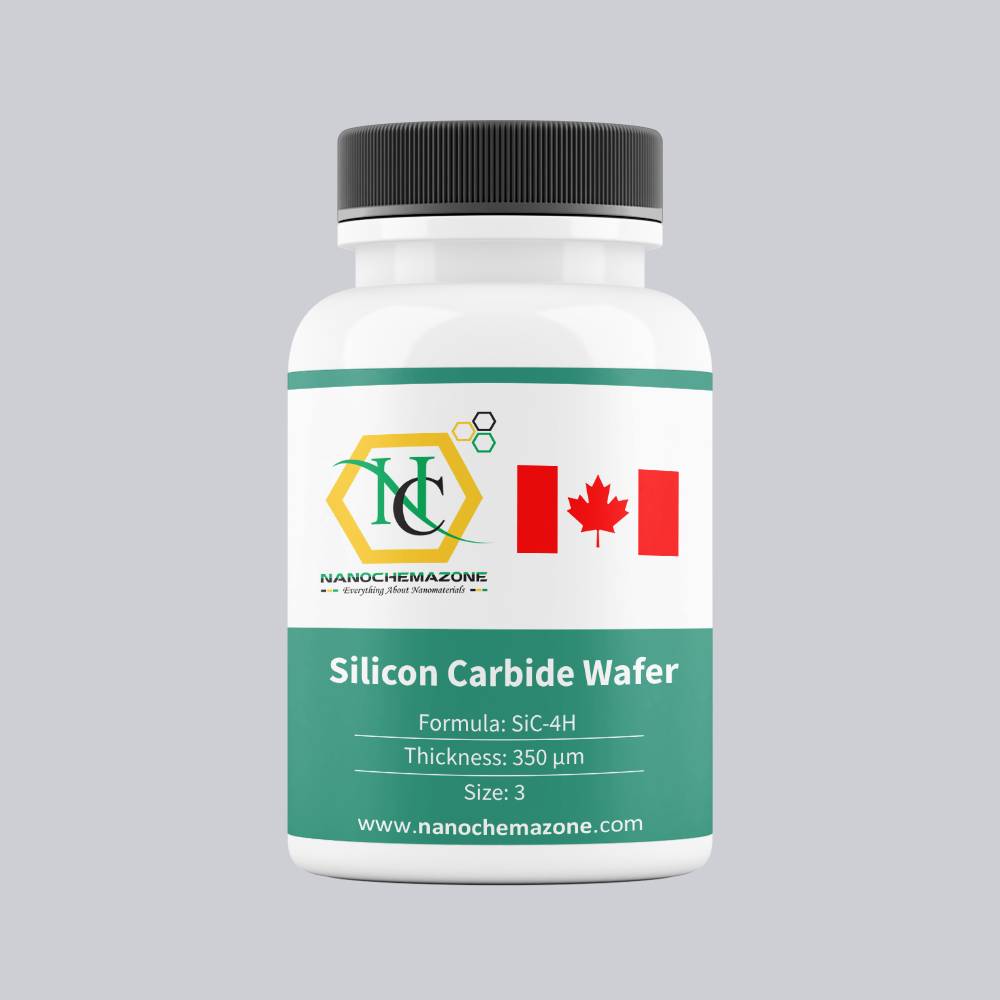
Silicon Carbide Wafer (SiC-4H) – 4H, Size: 3”, Thickness: 350 μm, Research Grade, 4H Area: 95%

Price range: $936.00 through $4,176.00
Select options This product has multiple variants. The options may be chosen on the product page
Silicon Carbide Wafer (SiC-4H) – 4H Size: 3”, Thickness: 350 μm, 4H Area: 95% Technical Properties: Quality  Research Grade Size (inch)  3”

Silicon Carbide Wafer (SiC-4H) – 4H, Size: 4”, Thickness: 350 μm, Testing Grade, 4H Area: 95%

Price range: $827.00 through $4,069.00
Select options This product has multiple variants. The options may be chosen on the product page
1 piece/750 € 5 pieces/3690 €                 Please contact us for quotes on larger quantities !!!

Silicon Carbide Wafer (SiC-4H)- 4H

Size: 4'', Thickness: 350 μm, 4H Area: 95%

Technical Properties:

Quality  Testing Grade
Size (inch)  4”
Thickness (μm)  350
Ra  ≤0.3
4H area  95%
Orientation  4°±0.5°
Resistivity   0.015-0.03
TTV  ≤25
Bow  ≤30
Warp  ≤35
OF Length  32.5±2
IF Length  18±2

Fields of Application for Silicon Carbide (SiC-4H) - 4H Wafer

Silicon carbide (SiC) is a rare compound of silicon and carbon which is synthetically produced. Silicon carbide (SiC) wafer has great electrical properties and excellent thermal properties. Silicon carbide (SiC) wafer has low thermal expansion. Silicon carbide (SiC) wafer has superior hardness properties. Silicon carbide (SiC) wafer performs well at high temperatures. Also, silicon carbide (SiC) wafer has high resistance to corrosion, erosion and oxidation. In addition to, silicon carbide (SiC) wafer is also more shiny than either diamonds or cubic zirconia. Silicon carbide (SiC) crystals have unique physical and electronic properties. Silicon Carbide based devices have been used for short wavelength opto-electronic, high temperature, radiation resistant applications.  The high-power and high-frequency electronic devices made with SiC are superior to Si and GaAs based devices.  Below are some popular applications of SiC substrates. SiC based devices have low lattice mismatch with III-nitride epitaxial layers.  They have high thermal conductivity and can be used for the monitoring of combustion processes and for all sorts of UV-detection.  SiC-based semiconductor devices can work under very hostile environments, such as high temperature, high power, and high radiation conditions. SiC is used for the fabrication of very high-voltage and high-power devices such as diodes, power transistors, and high power microwave devices. Compared to conventional Si-devices, SiC-based power devices have faster switching speed higher voltages, lower parasitic resistances, smaller size, less cooling required due to high-temperature capability. While Silicon carbide (SiC-4H) - 4H wafer has superior electronic properties, silicon carbide (SiC-6H) – 6H wafer is most easily prepared and best studied.
  • Silicon carbide (SiC) wafer is used for hybrid and electric vehicles.
  • Silicon carbide (SiC) wafer is used for green energy generation.
  • Silicon carbide (SiC) wafer is used for LEDs.
  • Silicon carbide (SiC) wafer is used for many other emerging markets.

Silicon on Insulator (SOI) Wafers, Size: 4”, Thickness: 725 μm, P type (Boron doped)

Price range: $898.00 through $3,936.00
Select options This product has multiple variants. The options may be chosen on the product page
Silicon on Insulator (SOI) Wafers Size: 4”, Thickness: 750 μm, P type (Boron doped) Technical Properties: Size (inch)  4” Thickness (μm)

Indium Phosphide (InP) Wafers, Size: 3”, Thickness: 600± 25 μm, Orientation: 100, Single Side Polished, EPI-Ready, Dopant: Iron (N Type)

Price range: $822.00 through $3,936.00
Select options This product has multiple variants. The options may be chosen on the product page
Indium Phosphide (InP) Wafers Size: 3”, Thickness: 600± 25 μm, Orientation: 100 Technical Properties: Size (inch)  3” Thickness (μm)  600±

Indium Phosphide (InP) Wafers, Size: 3”, Thickness: 600± 25 μm, Orientation: 111 , Single Side Polished, EPI-Ready, Dopant: Iron (N Type)

Price range: $822.00 through $3,936.00
Select options This product has multiple variants. The options may be chosen on the product page
Indium Phosphide (InP) Wafers Size: 3”, Thickness: 600± 25 μm, Orientation: 111 Technical Properties: Size (inch)  3” Thickness (μm)  600±

Silicon Carbide Wafer (SiC-4H) – 4H, Size: 3”, Thickness: 350 μm, Research Grade, 4H Area: 95%

Price range: $860.00 through $3,837.00
Select options This product has multiple variants. The options may be chosen on the product page
1 piece/780 € 5 pieces/3480 €               Please contact us for quotes on larger quantities !!!

Silicon Carbide Wafer (SiC-4H) - 4H

Size: 3'', Thickness: 350 μm, 4H Area: 95%

Technical Properties:

Quality  Research Grade
Size (inch)  3”
Thickness (μm)  350
Ra  ≤0.3
4H area  95%
Orientation  4°±0.5°
Resistivity   0.015-0.03
TTV  ≤15
Bow  ≤10
Warp  ≤35
OF Length  22.0±2.0
IF Length  11.0±1.5

Fields of Application for Silicon Carbide (SiC-4H)- 4H Wafer

Silicon carbide (SiC) is a rare compound of silicon and carbon which is synthetically produced. Silicon carbide (SiC) wafer has great electrical properties and excellent thermal properties. Silicon carbide (SiC) wafer has low thermal expansion. Silicon carbide (SiC) wafer has superior hardness properties. Silicon carbide (SiC) wafer performs well at high temperatures. Also, silicon carbide (SiC) wafer has high resistance to corrosion, erosion and oxidation. In addition to, silicon carbide (SiC) wafer is also more shiny than either diamonds or cubic zirconia. While Silicon carbide (SiC-4H) - 4H wafer has superior electronic properties, silicon carbide (SiC-6H) – 6H wafer is most easily prepared and best studied.
  • Silicon carbide (SiC) wafer is used for hybrid and electric vehicles.
  • Silicon carbide (SiC) wafer is used for green energy generation.
  • Silicon carbide (SiC) wafer is used for LEDs.
  • Silicon carbide (SiC) wafer is used for many other emerging markets.

Indium Phosphide (InP) Wafers, Size: 4”, Thickness: 625± 25 μm, Orientation: 100, Single Side Polished, Testing Grade

Price range: $828.00 through $3,816.00
Select options This product has multiple variants. The options may be chosen on the product page
Indium Phosphide (InP) Wafers Size: 4”, Thickness: 625± 25 μm, Orientation: 100 Technical Properties: Size (inch)  4” Thickness (μm)  625±

Indium Phosphide (InP) Wafers, Size: 4”, Thickness: 625± 25 μm, Orientation: 111, Single Side Polished, Testing Grade

Price range: $828.00 through $3,816.00
Select options This product has multiple variants. The options may be chosen on the product page
Indium Phosphide (InP) Wafers Size: 4”, Thickness: 625± 25 μm, Orientation: 111 Technical Properties: Size (inch) 4” Thickness (μm) 625±

Gallium Antimonide (GaSb) Wafers, Size: 3”, Thickness: 625± 25 μm, Orientation: 100, Testing Grade

Price range: $813.00 through $3,801.00
Select options This product has multiple variants. The options may be chosen on the product page
Gallium Antimonide (GaSb) Wafers Size: 3”, Thickness: 625± 25 μm, Orientation: 111 Technical Properties: Quality  Testing Grade Size (inch)  3” Thickness

Gallium Antimonide (GaSb) Wafers, Size: 3”, Thickness: 625± 25 μm, Orientation: 111, Testing Grade

Price range: $813.00 through $3,801.00
Select options This product has multiple variants. The options may be chosen on the product page
Gallium Antimonide (GaSb) Wafers Size: 3”, Thickness: 625± 25 μm, Orientation: 111 Technical Properties: Quality  Testing Grade Size (inch)  3” Thickness

Prime CZ-Si Wafer, Size: 8”, Orientation: (100), Boron Doped, Resistivity: 1000-10000 (ohm.cm), 1-Side Polished, Thickness: 725 ± 25 μm

Price range: $182.00 through $3,795.00
Select options This product has multiple variants. The options may be chosen on the product page
1 piece/163 € 5 pieces/710 € 25 pieces/3390 € Please contact us for quotes on larger quantities !!!

Prime CZ-Si Wafer

Size: 8”, Orientation: (100), Boron Doped, 1-Side Polished, Thickness: 725 ± 25 μm

Technical Properties:

Quality Prime
Materials CZ-Si
Size (inch) 8”
Orientation (100)
Coating  
Thickness (μm) 725 ± 25 μm
Doping Boron
Resistivity (ohm.cm) 1000-10000
Polished One Side
Silicon is one of the most common elements on earths crust. Main usage of Silicon wafers is electronics and technology. Silicon wafers have very flat and mirror like surfaces. It is produced by Czochralski method to obtain the highest purity. Depending on the usage area, silicon wafers can be doped with different materials to tailor its purity accordingly. The amount and type of dopants highly affect the electronic properties. Galium, indium, boron and nitrogen are some of the dopants that can be used in production process. Silicon wafers are used in semiconductors, microchips, integrated circuits, smartphones, computers etc. Silicon is the key platform for semiconductor gadgets. A wafer is just but a thin slice of the semiconductor material that acts as a substratum for microelectronic devices fitted in and above the wafer.

Gallium Arsenide (GaAs) Wafers, Size: 4”, Thickness: 625±25 μm, Single Side Polished, EPI-ready

Price range: $198.45 through $3,768.00
Select options This product has multiple variants. The options may be chosen on the product page
Gallium Arsenide (GaAs) Wafer Size: 4”, Thickness: 625±25 μm, Single Side Polished Technical Properties: Quality  GaAs Materials  GaAs Size (inch)

Gallium Arsenide (GaAs) Wafers, Size: 4”, Thickness: 350± 25 μm, Single Side Polished, EPI-ready, Mobility: 1000-3000

Price range: $198.45 through $3,768.00
Select options This product has multiple variants. The options may be chosen on the product page
Gallium Arsenide (GaAs) Wafer Size: 4”, Thickness: 350± 25 μm, Mobility: 1000-3000 Technical Properties: Quality  GaAs Materials  GaAs Size (inch)  4”

Silicon Carbide Wafer (SiC-4H) – 4H, Size: 4”, Thickness: 350 μm, Testing Grade, 4H Area: 95%

Price range: $750.00 through $3,690.00
Select options This product has multiple variants. The options may be chosen on the product page
Silicon Carbide Wafer (SiC-4H)- 4H Size: 4”, Thickness: 350 μm, 4H Area: 95% Technical Properties: Quality  Testing Grade Size (inch)  4” Thickness

Indium Phosphide (InP) Wafers, Size: 3”, Thickness: 600± 25 μm, Orientation: 100, Single Side Polished, EPI-Ready, Dopant: Iron (N Type)

Price range: $760.00 through $3,641.00
Select options This product has multiple variants. The options may be chosen on the product page
1 piece/685  5 pieces/3280                       Please contact us for quotes on larger quantities !!!

Indium Phosphide (InP) Wafers

Size: 3'', Thickness: 600± 25 μm, Orientation: 100

Technical Properties:

Size (inch)  3”
Thickness (μm)  600± 25
Dopant  Iron ( N type )
Polished  Single Side
Mobility (1.5-3.5)E3
Orientation  100
EPD  ≤5000
Growth method  VGF
OF Length  22±2
IF Length   11±1
Resistivity  1E7 Ohmcm

Fields of Application for Indium Phosphide (InP)

Indium phosphide (InP) is a binary semiconductor composed of indium and phosphorus. Indium phosphide (InP) has started to be developed at the beginning of 1980s. Indium phosphide (InP) which used in a high power and high frequency electronics, has superior electron velocity. Indium phosphide (InP) has a direct bandgap by contrast with many semiconductors. This makes indium phosphide (InP) useful for optoelectronics and laser diodes. Indium phosphide (InP) is a crucial material for production of laser signals, determination and conversion of those signals back to electronic form. Indium Phopshide (InP) is a binary semiconductor composed of Indium (In) and Phosphorus (P), belonging to a group of materials commonly known as III-V Semiconductors. InP is used in high power and high-frequency electronics and boasts a superior electron velocity in comparison to more common semiconductors such as Silicon and Gallium Arsenide. Indium Phosphide has a face-centred cubic crystal structure almost identical to that of GaAs and most of the lll-V semiconductors. InP wafers must be prepared prior to device fabrication, all III-V wafers must be lapped to remove surface damage that occurs during the slicing process. Wafers are then Chemically Mechanically Polished/Plaranrized (CMP) for the final material removal stage allowing for the attainment of super-flat mirror like surfaces with a remaining roughness on an atomic scale. The wafer is then ready for device fabrication.
  • Indium phosphide (InP) is used in modulators.
  • Indium phosphide (InP) is used in photo-detectors.
  • Indium phosphide (InP) is used in LEDs.
  • Indium phosphide (InP) is used in fiber communications components.
  • Indium phosphide (InP) is used in semiconductor optical amplifiers.

Indium Phosphide (InP) Wafers, Size: 3”, Thickness: 600± 25 μm, Orientation: 111 , Single Side Polished, EPI-Ready, Dopant: Iron (N Type)

Price range: $760.00 through $3,641.00
Select options This product has multiple variants. The options may be chosen on the product page
1 piece/685  5 pieces/3280                            Please contact us for quotes on larger quantities !!!

Indium Phosphide (InP) Wafers

Size: 3'', Thickness: 600± 25 μm, Orientation: 111

Technical Properties:

Size (inch)  3”
Thickness (μm)  600± 25
Dopant  Iron (N type)
Polished  Single Side
Mobility (1.5-3.5)E3
Orientation  111
EPD  ≤5000
Growth method  VGF
OF Length  22±2
IF Length   11±1
Resistivity  1E7 Ohmcm

Fields of Application for Indium Phosphide (InP)

Indium phosphide (InP) is a binary semiconductor composed of indium and phosphorus. Indium phosphide (InP) has started to be developed at the beginning of 1980s. Indium phosphide (InP) which used in a high power and high frequency electronics, has superior electron velocity. Indium phosphide (InP) has a direct bandgap by contrast with many semiconductors. This makes indium phosphide (InP) useful for optoelectronics and laser diodes. Indium phosphide (InP) is a crucial material for production of laser signals, determination and conversion of those signals back to electronic form. Indium Phopshide (InP) is a binary semiconductor composed of Indium (In) and Phosphorus (P), belonging to a group of materials commonly known as III-V Semiconductors. InP is used in high power and high-frequency electronics and boasts a superior electron velocity in comparison to more common semiconductors such as Silicon and Gallium Arsenide.
  • Indium phosphide (InP) is used in modulators.
  • Indium phosphide (InP) is used in photo-detectors.
  • Indium phosphide (InP) is used in LEDs.
  • Indium phosphide (InP) is used in fiber communications components.
  • Indium phosphide (InP) is used in semiconductor optical amplifiers.

Silicon on Insulator (SOI) Wafers, Size: 4”, Thickness: 725 μm, P type (Boron doped)

Price range: $760.00 through $3,617.00
Select options This product has multiple variants. The options may be chosen on the product page
1 piece/690 € 5 pieces/3280 €                           Please ask for stock status before placing an order on wafer products   Please contact us for quotes on larger quantities !!!

Silicon on Insulator (SOI) Wafers

Size: 4'', Thickness: 750 μm, P type (Boron doped)

Technical Properties:

Size (inch)  4”
Thickness (μm)  725
Resistivity   1-100 ohm.cm
Grade  Prime
Dopant  P type (Boron doped )
Orientation  100
Device Thickness  300 nm
Device Resistivity   1-100 ohm.cm
Device Type  P type (Boron doped )
Device Orientation  100
BOX Thickness  500 nm

Fields of Application for Silicon on Insulator (SOI) Wafer

Silicon on insulator (SOI) wafer is obtained with the addition of insulating layer. Silicon on insulator (SOI) wafer is placed between silicon substrate and an upper layer of silicon. The fundamental aim of using silicon on insulator (SOI) wafer is to increase the performance of the conventional silicon wafer by decreasing electrical losses. In case of reducing power and heat while increasing the speed performance of a device silicon on insulator (SOI) wafer is helpful. Best insulation depends on the application aims, for instance silicon dioxide is the most common insulator in microelectronics since it has ability to reduce short-channel effects. Silicon on insulator (SOI) wafer has reduced temperature dependency due to no doping and better yield due to high density. Silicon on insulator wafers helps to reduce the heat and increase the speed. Are the most common wafers for integrated circuit production. Mainly used where traditional silicon wafers are ineffective. High density of SOI wafers increases the utilization of such products. SOI wafers are commonly used in silicon photonics. The silicon layer on insulator can be used to fabricate optical waveguides and other optical devices, either passive or active (e.g. through suitable implantations). The buried insulator enables propagation of infrared light in the silicon layer on the basis of total internal reflection. The top surface of the waveguides can be either left uncovered and exposed to air (e.g. for sensing applications), or covered with a cladding, typically made of silica.
  • Silicon on insulator (SOI) wafer is used in silicon photonics.
  • Silicon on insulator (SOI) wafer is used in microelectronic devices.
  • Silicon on insulator (SOI) wafer is used for radio frequency (RF).

Gallium Arsenide (GaAs) Wafers, Size: 2”, Thickness: 350± 25 μm, Orientation: 100, Single Side Polished, EPI-ready

Price range: $189.00 through $3,588.00
Select options This product has multiple variants. The options may be chosen on the product page
Gallium Arsenide (GaAs) Wafer Size: 2”, Thickness: 350±25 μm, Orientation: 100 Technical Properties: Quality  GaAs Materials  GaAs Size (inch)  2”

Gallium Arsenide (GaAs) Wafers, Size: 2”, Thickness: 350±25 μm, Single Side Polished, EPI-ready, Mobility: 1000-3000

Price range: $189.00 through $3,588.00
Select options This product has multiple variants. The options may be chosen on the product page
Gallium Arsenide (GaAs) Wafer Size: 2”, Thickness: 350±25 μm, Mobility: 1000-3000 Technical Properties: Quality  GaAs Materials  GaAs Size (inch)  2” Thickness

Gallium Arsenide (GaAs) Wafers, Size: 2”, Thickness: 350±25 μm, Double Side Polished, EPI-ready

Price range: $189.00 through $3,588.00
Select options This product has multiple variants. The options may be chosen on the product page
Gallium Arsenide (GaAs) Wafer Size: 2”, Thickness: 350±25 μm, Double Side Polished Technical Properties: Quality  GaAs Materials  GaAs Size (inch)

Gallium Arsenide (GaAs) Wafers, Size: 4”, Thickness: 350±25 μm, Single Side Polished, EPI-ready

Price range: $189.00 through $3,588.00
Select options This product has multiple variants. The options may be chosen on the product page
Gallium Arsenide (GaAs) Wafer Size: 4”, Thickness: 350±25 μm, Single Side Polished Technical Properties: Quality  GaAs Materials  GaAs Size (inch)

Indium Arsenide (InAs) Wafers, Size: 2”, Thickness: 500± 25 μm, Orientation: 100, EPI-Ready

Price range: $784.00 through $3,585.00
Select options This product has multiple variants. The options may be chosen on the product page
Indium Arsenide (InAs) Wafers Size: 2”, Thickness: 500± 25 μm, Orientation: 100 Technical Properties: Quality  EPI-Ready Size (inch)  2” Thickness

Silicon Carbide Wafer (SiC-4H) – 4H, Size: 2”, Thickness: 350 μm, Production Grade, 4H Area: 1

Price range: $813.00 through $3,571.00
Select options This product has multiple variants. The options may be chosen on the product page
Silicon Carbide Wafer (SiC-4H) – 4H Size: 2”, Thickness: 350 μm, 4H Area: 1 Technical Properties: Quality  Production Grade Size (inch)  2”

Indium Phosphide (InP) Wafers, Size: 4”, Thickness: 625± 25 μm, Orientation: 100, Single Side Polished, Testing Grade

Price range: $766.00 through $3,530.00
Select options This product has multiple variants. The options may be chosen on the product page
1 piece/690  5 pieces/3180                           Please contact us for quotes on larger quantities !!!

Indium Phosphide (InP) Wafers

Size: 4'', Thickness: 625± 25 μm, Orientation: 100

Technical Properties:

Size (inch)  4”
Thickness (μm)  625± 25
Dopant  Sulphur (N type)
Polished  Single Side
Mobility (1.5-3.5)E3
Orientation  100
EPD  ≤5000
Growth method  VGF
OF Length  32.5±2
IF Length   18±1

Fields of Application for Indium Phosphide (InP)

Indium phosphide (InP) is a binary semiconductor composed of indium and phosphorus. Indium phosphide (InP) has started to be developed at the beginning of 1980s. Indium phosphide (InP) which used in a high power and high frequency electronics, has superior electron velocity. Indium phosphide (InP) has a direct bandgap by contrast with many semiconductors. This makes indium phosphide (InP) useful for optoelectronics and laser diodes. Indium phosphide (InP) is a crucial material for production of laser signals, determination and conversion of those signals back to electronic form. Indium Phopshide (InP) is a binary semiconductor composed of Indium (In) and Phosphorus (P), belonging to a group of materials commonly known as III-V Semiconductors. InP is used in high power and high-frequency electronics and boasts a superior electron velocity in comparison to more common semiconductors such as Silicon and Gallium Arsenide. Indium Phosphide has a face-centred cubic crystal structure almost identical to that of GaAs and most of the lll-V semiconductors. InP wafers must be prepared prior to device fabrication, all III-V wafers must be lapped to remove surface damage that occurs during the slicing process. Wafers are then Chemically Mechanically Polished/Plaranrized (CMP) for the final material removal stage allowing for the attainment of super-flat mirror like surfaces with a remaining roughness on an atomic scale. The wafer is then ready for device fabrication.
  • Indium phosphide (InP) is used in modulators.
  • Indium phosphide (InP) is used in photo-detectors.
  • Indium phosphide (InP) is used in LEDs.
  • Indium phosphide (InP) is used in fiber communications components.
  • Indium phosphide (InP) is used in semiconductor optical amplifiers.

Indium Phosphide (InP) Wafers, Size: 4”, Thickness: 625± 25 μm, Orientation: 111, Single Side Polished, Testing Grade

Price range: $766.00 through $3,530.00
Select options This product has multiple variants. The options may be chosen on the product page
1 piece/690  5 pieces/3180                          Please contact us for quotes on larger quantities !!!

Indium Phosphide (InP) Wafers

Size: 4'', Thickness: 625± 25 μm, Orientation: 111

Technical Properties:

Size (inch)  4”
Thickness (μm)  625± 25
Dopant  Sulphur (N type)
Polished  Single Side
Mobility (1.5-3.5)E3
Orientation  111
EPD  ≤5000
Growth method  VGF
OF Length  32.5±2
IF Length   18±1

Fields of Application for Indium Phosphide (InP)

Indium phosphide (InP) is a binary semiconductor composed of indium and phosphorus. Indium phosphide (InP) has started to be developed at the beginning of 1980s. Indium phosphide (InP) which used in a high power and high frequency electronics, has superior electron velocity. Indium phosphide (InP) has a direct bandgap by contrast with many semiconductors. This makes indium phosphide (InP) useful for optoelectronics and laser diodes. Indium phosphide (InP) is a crucial material for production of laser signals, determination and conversion of those signals back to electronic form. Indium Phopshide (InP) is a binary semiconductor composed of Indium (In) and Phosphorus (P), belonging to a group of materials commonly known as III-V Semiconductors. InP is used in high power and high-frequency electronics and boasts a superior electron velocity in comparison to more common semiconductors such as Silicon and Gallium Arsenide. Indium Phosphide has a face-centred cubic crystal structure almost identical to that of GaAs and most of the lll-V semiconductors. InP wafers must be prepared prior to device fabrication, all III-V wafers must be lapped to remove surface damage that occurs during the slicing process. Wafers are then Chemically Mechanically Polished/Plaranrized (CMP) for the final material removal stage allowing for the attainment of super-flat mirror like surfaces with a remaining roughness on an atomic scale. The wafer is then ready for device fabrication.
  • Indium phosphide (InP) is used in modulators.
  • Indium phosphide (InP) is used in photo-detectors.
  • Indium phosphide (InP) is used in LEDs.
  • Indium phosphide (InP) is used in fiber communications components.
  • Indium phosphide (InP) is used in semiconductor optical amplifiers.

Gallium Arsenide (GaAs) Wafers, Size: 4”, Thickness: 640±25 μm, Single Side Polished, EPI-ready, Dopant: Silicon (N-type)

Price range: $165.00 through $3,450.00
Select options This product has multiple variants. The options may be chosen on the product page
Gallium Arsenide (GaAs) Wafer Size: 4”, Single Side Polished, Thickness: 640± 25 μm, EPI-ready, Dopant: Silicon (N-type) Technical Properties: Quality

Prime CZ-Si Wafer, Size: 8”, Orientation: (100), Boron Doped, Resistivity: 1-100 (ohm.cm), 1-Side Polished, Thickness: 725 ± 25 μm

Price range: $163.00 through $3,390.00
Select options This product has multiple variants. The options may be chosen on the product page
Prime CZ-Si Wafer Size: 8”, Orientation: (100), Boron Doped, 1-Side Polished, Thickness: 725 ± 25 μm Technical Properties: Quality Prime

Gallium Arsenide (GaAs) Wafers, Size: 4”, Thickness: 350±25 μm, Single Side Polished, EPI-ready

Price range: $175.00 through $3,319.00
Select options This product has multiple variants. The options may be chosen on the product page
1 piece/158  5 pieces/749  25 pieces/2990  Please contact us for quotes on larger quantities !!!

Gallium Arsenide (GaAs) Wafer

Size: 4”, Thickness: 350±25 μm, Single Side Polished

Technical Properties:

Quality  GaAs
Materials  GaAs
Size (inch)  2”
Thickness (μm)  350± 25
Polished  Single Side
Dopant  Silicon (N Type)
Orientation  (100)15 deg off toward <111>A±0.5
Resistivity   (1.2—9.9) E-3
Mobility  1000-3000
EPD  ≤3000
Growth method  VGF
OF Length  32±1
IF Length   18±1

Fields of Application for Gallium Arsenide (GaAs)

Gallium arsenide (GaAs) is a compound of the elements gallium and arsenic. Gallium arsenide (GaAs) is a semiconductor compound. Gallium arsenide (GaAs)  has a high electron velocity and high saturated electron mobility. This makes gallium arsenide (GaAs) components are useful in fast electronic switching applications and at ultra-high radio frequencies. In 1907, the British discovered infrared emmission from gallium arsenide. This was called electroluminescence. Also, gallium arsenide (GaAs) was used as a solar cells in space for the Venera 3 mission in 1965, which is the first known operational use of gallium arsenide (GaAs). Vertical gradient freeze is the most common method to produce GaAs wafers. Mainly used for circuits, electronics and solar cell applications. Carbon, silicon, tellurium and zinc are some of the dopants that are used to modify the characteristics and electrical properties of gallium arsenide wafers. Wafer flatness and surface purity are ensured by highest quality standards. Boron concentration of gallium arsenide wafers highly depend on the production method. Gallium arsenide wafers with adequate electrical resistancy prevent high current induction in the circuit. Mobility of GaAs wafers can be tailored with different doping levels.
  • Gallium arsenide (GaAs) is used in laser diodes.
  • Gallium arsenide (GaAs) is used in solar cells.
  • Gallium arsenide (GaAs) is used in optical windows.
  • Gallium arsenide (GaAs) is used in monolithic microwave integrated circuits.
  • Gallium arsenide (GaAs) is used in microwave frequency integrated circuits.
  • Gallium arsenide (GaAs) is used in infrared light-emitting diodes.
  • Gallium arsenide (GaAs) is useful in barometers.
  • Gallium arsenide (GaAs) is useful in pharmaceuticals and nuclear medicine tests.
  • Gallium arsenide (GaAs) is useful in high temperature thermometers.

Gallium Arsenide (GaAs) Wafers, Size: 4”, Thickness: 625±25 μm, Single Side Polished, EPI-ready

Price range: $175.00 through $3,319.00
Select options This product has multiple variants. The options may be chosen on the product page
1 piece/158  5 pieces/749  25 pieces/2990    Please ask for stock status before placing an order on wafer products   Please contact us for quotes on larger quantities !!!

Gallium Arsenide (GaAs) Wafer

Size: 4”, Thickness: 625±25 μm, Single Side Polished

Technical Properties:

Quality  GaAs
Materials  GaAs
Size (inch)  4”
Thickness (μm)  625± 25
Polished  Single Side
Dopant  Silicon (N Type)
Orientation  (100)
Resistivity   (1.2—9.9) E-3
Mobility  1000-3000
EPD  ≤3000
Growth method  VGF
OF Length  32±1
IF Length   18±1

Fields of Application for Gallium Arsenide (GaAs)

Gallium arsenide (GaAs) is a compound of the elements gallium and arsenic. Gallium arsenide (GaAs) is a semiconductor compound. Gallium arsenide (GaAs)  has a high electron velocity and high saturated electron mobility. This makes gallium arsenide (GaAs) components are useful in fast electronic switching applications and at ultra-high radio frequencies. In 1907, the British discovered infrared emmission from gallium arsenide. This was called electroluminescence. Also, gallium arsenide (GaAs) was used as a solar cells in space for the Venera 3 mission in 1965, which is the first known operational use of gallium arsenide (GaAs). Vertical gradient freeze is the most common method to produce GaAs wafers. Mainly used for circuits, electronics and solar cell applications. Carbon, silicon, tellurium and zinc are some of the dopants that are used to modify the characteristics and electrical properties of gallium arsenide wafers. Wafer flatness and surface purity are ensured by highest quality standards. Boron concentration of gallium arsenide wafers highly depend on the production method. Gallium arsenide wafers with adequate electrical resistancy prevent high current induction in the circuit. Mobility of GaAs wafers can be tailored with different doping levels.
  • Gallium arsenide (GaAs) is used in laser diodes.
  • Gallium arsenide (GaAs) is used in solar cells.
  • Gallium arsenide (GaAs) is used in optical windows.
  • Gallium arsenide (GaAs) is used in monolithic microwave integrated circuits.
  • Gallium arsenide (GaAs) is used in microwave frequency integrated circuits.
  • Gallium arsenide (GaAs) is used in infrared light-emitting diodes.
  • Gallium arsenide (GaAs) is useful in barometers.
  • Gallium arsenide (GaAs) is useful in pharmaceuticals and nuclear medicine tests.
  • Gallium arsenide (GaAs) is useful in high temperature thermometers.

Gallium Arsenide (GaAs) Wafers, Size: 4”, Thickness: 350± 25 μm, Single Side Polished, EPI-ready, Mobility: 1000-3000

Price range: $175.00 through $3,319.00
Select options This product has multiple variants. The options may be chosen on the product page
1 piece/158  5 pieces/749  25 pieces/2990  Please contact us for quotes on larger quantities !!!

Gallium Arsenide (GaAs) Wafer

Size: 4”, Thickness: 350± 25 μm, Mobility: 1000-3000

Technical Properties:

Quality  GaAs
Materials  GaAs
Size (inch)  4”
Thickness (μm)  350± 25
Polished  Single Side
Dopant  Silicon (N Type)
Orientation  (100)2deg off toward <011>±0.5
Resistivity   (1.2—9.9) E-3
Mobility  1000-3000
EPD  ≤3000
Growth method  VGF
OF Length  32±1
IF Length   18±1

Fields of Application for Gallium Arsenide (GaAs)

Gallium arsenide (GaAs) is a compound of the elements gallium and arsenic. Gallium arsenide (GaAs) is a semiconductor compound. Gallium arsenide (GaAs)  has a high electron velocity and high saturated electron mobility. This makes gallium arsenide (GaAs) components are useful in fast electronic switching applications and at ultra-high radio frequencies. In 1907, the British discovered infrared emmission from gallium arsenide. This was called electroluminescence. Also, gallium arsenide (GaAs) was used as a solar cells in space for the Venera 3 mission in 1965, which is the first known operational use of gallium arsenide (GaAs). Vertical gradient freeze is the most common method to produce GaAs wafers. Mainly used for circuits, electronics and solar cell applications. Carbon, silicon, tellurium and zinc are some of the dopants that are used to modify the characteristics and electrical properties of gallium arsenide wafers. Wafer flatness and surface purity are ensured by highest quality standards. Boron concentration of gallium arsenide wafers highly depend on the production method. Gallium arsenide wafers with adequate electrical resistancy prevent high current induction in the circuit. Mobility of GaAs wafers can be tailored with different doping levels.
  • Gallium arsenide (GaAs) is used in laser diodes.
  • Gallium arsenide (GaAs) is used in solar cells.
  • Gallium arsenide (GaAs) is used in optical windows.
  • Gallium arsenide (GaAs) is used in monolithic microwave integrated circuits.
  • Gallium arsenide (GaAs) is used in microwave frequency integrated circuits.
  • Gallium arsenide (GaAs) is used in infrared light-emitting diodes.
  • Gallium arsenide (GaAs) is useful in barometers.
  • Gallium arsenide (GaAs) is useful in pharmaceuticals and nuclear medicine tests.
  • Gallium arsenide (GaAs) is useful in high temperature thermometers.

Gallium Arsenide (GaAs) Wafers, Size: 2”, Thickness: 350± 25 μm, Orientation: 100, Single Side Polished, EPI-ready

Price range: $175.00 through $3,319.00
Select options This product has multiple variants. The options may be chosen on the product page
1 piece/158  5 pieces/749  25 pieces/2990  Please contact us for quotes on larger quantities !!!

Gallium Arsenide (GaAs) Wafer

Size: 2”, Thickness: 350±25 μm, Orientation: 100

Technical Properties:

Quality  GaAs
Materials  GaAs
Size (inch)  2”
Thickness (μm)  350± 25
Polished  Single Side
Dopant  Silicon (N type)
Orientation  (100)
Resistivity   (1.2—9.9) E-3
Mobility  1000-3000
EPD  ≤3000
Growth method  VGF
OF Length  17±1
IF Length   7±1

Fields of Application for Gallium Arsenide (GaAs)

Gallium arsenide (GaAs) is a compound of the elements gallium and arsenic. Gallium arsenide (GaAs) is a semiconductor compound. Gallium arsenide (GaAs)  has a high electron velocity and high saturated electron mobility. This makes gallium arsenide (GaAs) components are useful in fast electronic switching applications and at ultra-high radio frequencies. In 1907, the British discovered infrared emmission from gallium arsenide. This was called electroluminescence. Also, gallium arsenide (GaAs) was used as a solar cells in space for the Venera 3 mission in 1965, which is the first known operational use of gallium arsenide (GaAs). Vertical gradient freeze is the most common method to produce GaAs wafers. Mainly used for circuits, electronics and solar cell applications. Carbon, silicon, tellurium and zinc are some of the dopants that are used to modify the characteristics and electrical properties of gallium arsenide wafers. Wafer flatness and surface purity are ensured by highest quality standards. Boron concentration of gallium arsenide wafers highly depend on the production method. Gallium arsenide wafers with adequate electrical resistancy prevent high current induction in the circuit. Mobility of GaAs wafers can be tailored with different doping levels.
  • Gallium arsenide (GaAs) is used in laser diodes.
  • Gallium arsenide (GaAs) is used in solar cells.
  • Gallium arsenide (GaAs) is used in optical windows.
  • Gallium arsenide (GaAs) is used in monolithic microwave integrated circuits.
  • Gallium arsenide (GaAs) is used in microwave frequency integrated circuits.
  • Gallium arsenide (GaAs) is used in infrared light-emitting diodes.
  • Gallium arsenide (GaAs) is useful in barometers.
  • Gallium arsenide (GaAs) is useful in pharmaceuticals and nuclear medicine tests.
  • Gallium arsenide (GaAs) is useful in high temperature thermometers.

Gallium Arsenide (GaAs) Wafers, Size: 2”, Thickness: 350±25 μm, Single Side Polished, EPI-ready, Mobility: 1000-3000

Price range: $175.00 through $3,319.00
Select options This product has multiple variants. The options may be chosen on the product page
1 piece/158  5 pieces/749  25 pieces/2990  Please contact us for quotes on larger quantities !!!

Gallium Arsenide (GaAs) Wafer

Size: 2”, Thickness: 350±25 μm, Mobility: 1000-3000

Technical Properties:

Quality  GaAs
Materials  GaAs
Size (inch)  2”
Thickness (μm)  350± 25
Polished  Single Side
Dopant  Silicon (N type)
Orientation  (100)2 deg off toward <111>A±0.5
Resistivity   (1.2—9.9) E-3
Mobility  1000-3000
EPD  ≤3000
Growth method  VGF
OF Length  17±1
IF Length   7±1

Fields of Application for Gallium Arsenide (GaAs)

Gallium arsenide (GaAs) is a compound of the elements gallium and arsenic. Gallium arsenide (GaAs) is a semiconductor compound. Gallium arsenide (GaAs)  has a high electron velocity and high saturated electron mobility. This makes gallium arsenide (GaAs) components are useful in fast electronic switching applications and at ultra-high radio frequencies. In 1907, the British discovered infrared emmission from gallium arsenide. This was called electroluminescence. Also, gallium arsenide (GaAs) was used as a solar cells in space for the Venera 3 mission in 1965, which is the first known operational use of gallium arsenide (GaAs). Vertical gradient freeze is the most common method to produce GaAs wafers. Mainly used for circuits, electronics and solar cell applications. Carbon, silicon, tellurium and zinc are some of the dopants that are used to modify the characteristics and electrical properties of gallium arsenide wafers. Wafer flatness and surface purity are ensured by highest quality standards. Boron concentration of gallium arsenide wafers highly depend on the production method. Gallium arsenide wafers with adequate electrical resistancy prevent high current induction in the circuit. Mobility of GaAs wafers can be tailored with different doping levels.
  • Gallium arsenide (GaAs) is used in laser diodes.
  • Gallium arsenide (GaAs) is used in solar cells.
  • Gallium arsenide (GaAs) is used in optical windows.
  • Gallium arsenide (GaAs) is used in monolithic microwave integrated circuits.
  • Gallium arsenide (GaAs) is used in microwave frequency integrated circuits.
  • Gallium arsenide (GaAs) is used in infrared light-emitting diodes.
  • Gallium arsenide (GaAs) is useful in barometers.
  • Gallium arsenide (GaAs) is useful in pharmaceuticals and nuclear medicine tests.
  • Gallium arsenide (GaAs) is useful in high temperature thermometers.

Gallium Arsenide (GaAs) Wafers, Size: 2”, Thickness: 350±25 μm, Double Side Polished, EPI-ready

Price range: $175.00 through $3,319.00
Select options This product has multiple variants. The options may be chosen on the product page
1 piece/158  5 pieces/749  25 pieces/2990  Please contact us for quotes on larger quantities !!!

Gallium Arsenide (GaAs) Wafer

Size: 2”, Thickness: 350±25 μm, Double Side Polished

Technical Properties:

Quality  GaAs
Materials  GaAs
Size (inch)  2”
Thickness (μm)  350± 25
Polished  Double Side
Dopant  None
Orientation  (100)
Resistivity   1 E8
Mobility  2000
EPD  ≤5000
Growth method  VGF
OF Length  17±1
IF Length   7±1

Fields of Application for Gallium Arsenide (GaAs)

Gallium arsenide (GaAs) is a compound of the elements gallium and arsenic. Gallium arsenide (GaAs) is a semiconductor compound. Gallium arsenide (GaAs)  has a high electron velocity and high saturated electron mobility. This makes gallium arsenide (GaAs) components are useful in fast electronic switching applications and at ultra-high radio frequencies. In 1907, the British discovered infrared emmission from gallium arsenide. This was called electroluminescence. Also, gallium arsenide (GaAs) was used as a solar cells in space for the Venera 3 mission in 1965, which is the first known operational use of gallium arsenide (GaAs). Vertical gradient freeze is the most common method to produce GaAs wafers. Mainly used for circuits, electronics and solar cell applications. Carbon, silicon, tellurium and zinc are some of the dopants that are used to modify the characteristics and electrical properties of gallium arsenide wafers. Wafer flatness and surface purity are ensured by highest quality standards. Boron concentration of gallium arsenide wafers highly depend on the production method. Gallium arsenide wafers with adequate electrical resistancy prevent high current induction in the circuit. Mobility of GaAs wafers can be tailored with different doping levels.
  • Gallium arsenide (GaAs) is used in laser diodes.
  • Gallium arsenide (GaAs) is used in solar cells.
  • Gallium arsenide (GaAs) is used in optical windows.
  • Gallium arsenide (GaAs) is used in monolithic microwave integrated circuits.
  • Gallium arsenide (GaAs) is used in microwave frequency integrated circuits.
  • Gallium arsenide (GaAs) is used in infrared light-emitting diodes.
  • Gallium arsenide (GaAs) is useful in barometers.
  • Gallium arsenide (GaAs) is useful in pharmaceuticals and nuclear medicine tests.
  • Gallium arsenide (GaAs) is useful in high temperature thermometers.

Gallium Arsenide (GaAs) Wafers, Size: 2”, Thickness: 350±25 μm, Single Side Polished, EPI-ready, Dopant: Zinc (P Type)

Price range: $175.00 through $3,319.00
Select options This product has multiple variants. The options may be chosen on the product page
1 piece/158  5 pieces/749  25 pieces/2990  Please contact us for quotes on larger quantities !!!

Gallium Arsenide (GaAs) Wafer

Size: 2”, Thickness: 350±25 μm, Dopant: Zinc (P Type)

Technical Properties:

Quality  GaAs
Materials  GaAs
Size (inch)  2”
Thickness (μm)  350± 25
Polished  Single Side
Dopant  Zinc (P Type)
Orientation  (100)15 deg off toward<111A>
Resistivity   (1.2—9.9) E-3
Mobility  1000-3000
EPD  ≤3000
Growth method  VGF
OF Length  17±1
IF Length   7±1

Fields of Application for Gallium Arsenide (GaAs)

Gallium arsenide (GaAs) is a compound of the elements gallium and arsenic. Gallium arsenide (GaAs) is a semiconductor compound. Gallium arsenide (GaAs)  has a high electron velocity and high saturated electron mobility. This makes gallium arsenide (GaAs) components are useful in fast electronic switching applications and at ultra-high radio frequencies. In 1907, the British discovered infrared emmission from gallium arsenide. This was called electroluminescence. Also, gallium arsenide (GaAs) was used as a solar cells in space for the Venera 3 mission in 1965, which is the first known operational use of gallium arsenide (GaAs). Vertical gradient freeze is the most common method to produce GaAs wafers. Mainly used for circuits, electronics and solar cell applications. Carbon, silicon, tellurium and zinc are some of the dopants that are used to modify the characteristics and electrical properties of gallium arsenide wafers. Wafer flatness and surface purity are ensured by highest quality standards. Boron concentration of gallium arsenide wafers highly depend on the production method. Gallium arsenide wafers with adequate electrical resistancy prevent high current induction in the circuit. Mobility of GaAs wafers can be tailored with different doping levels.
  • Gallium arsenide (GaAs) is used in laser diodes.
  • Gallium arsenide (GaAs) is used in solar cells.
  • Gallium arsenide (GaAs) is used in optical windows.
  • Gallium arsenide (GaAs) is used in monolithic microwave integrated circuits.
  • Gallium arsenide (GaAs) is used in microwave frequency integrated circuits.
  • Gallium arsenide (GaAs) is used in infrared light-emitting diodes.
  • Gallium arsenide (GaAs) is useful in barometers.
  • Gallium arsenide (GaAs) is useful in pharmaceuticals and nuclear medicine tests.
  • Gallium arsenide (GaAs) is useful in high temperature thermometers.