Lanthanum Strontium Manganate (La0.7Sr0.3MnO3) Sputtering Targets, Purity: 99.9%, Size: 2”, Thickness: 0.250”

$792.00
but allow experts a large degree of control over the growth and microstructure of the area.

Applications of Sputtering Targets;

  • Sputtering targets is used for film deposition. The deposition made by sputter targets is a method of depositing thin films by sputtering that involves eroding material from a "target" source onto a "substrate" such as  a silicon wafer.
  • Semiconductor sputtering targets is used to etch the target. Sputter etching is chosen in cases where a high degree of etching anisotropy is needed and selectivity is not a concern.
  • Sputter targets is also used for analysis by etching away the target material.
One of the example occurs  in secondary ion spectroscopy (SIMS), where the target sample is sputtered at a constant rate. As the target is sputtered, the concentration and identity of sputtered atoms are measured using mass spectrometry. By helping of the sputtering target, the composition of the target material can be determined and even extremely low concentrations of impurities are detected. Sputtering target has also application area in space. Sputtering is one of the forms of space weathering, a process that changes the physical and chemical properties of airless bodies, such as asteroids and the Moon.

Lithium Phosphate (Li3PO4) Sputtering Targets, elastomer, Purity: 99.95%, Size: 1”, Thickness: 0.125”

$792.00

Applications of Sputtering Targets;

Film deposition is accomplished using sputtering targets. A technique for sputtering thin films is called "deposition made by sputter targets," which entails eroding material from a "target" source onto a "substrate" like a silicon wafer. Etching of the target is done using semiconductor sputtering targets. When selectivity is not an issue and a high degree of etching anisotropy is required, sputter etching is the method of choice. By removing the target material through etching, sputter targets are also utilized for investigation. In secondary ion spectroscopy (SIMS), one example is when the target material is sputtered at a steady pace. Mass spectrometry is used to quantify the concentration and identity of spewed atoms as the target is sputtered.

By helping of the sputtering target, the composition of the target material may be evaluated and even extremely tiny amounts of contaminants are recognized.

There is also an application area for sputtering targets in space. One type of space weathering that alters the chemical and physical characteristics of airless worlds like the Moon and asteroids is sputtering.

Magnesium Fluoride (MgF2) Sputtering Targets, Purity: 99.9%, Size: 6”, Thickness: 0.250”

$792.00

Applications of Sputtering Targets;

Film deposition is accomplished using sputtering targets. A technique for sputtering thin films is called "deposition made by sputter targets," which entails eroding material from a "target" source onto a "substrate" like a silicon wafer. Etching of the target is done using semiconductor sputtering targets. When selectivity is not an issue and a high degree of etching anisotropy is required, sputter etching is the method of choice. By removing the target material through etching, sputter targets are also utilized for investigation. In secondary ion spectroscopy (SIMS), one example is when the target material is sputtered at a steady pace. Mass spectrometry is used to quantify the concentration and identity of spewed atoms as the target is sputtered.

By helping of the sputtering target, the composition of the target material may be evaluated and even extremely tiny amounts of contaminants are recognized.

There is also an application area for sputtering targets in space. One type of space weathering that alters the chemical and physical characteristics of airless worlds like the Moon and asteroids is sputtering.

Lithium Cobalt Oxide (LiCoO2) Sputtering Targets, Purity: 99.9%, Size: 3”, Thickness: 0.250”

$794.00

Applications of Sputtering Targets;

Film deposition is accomplished using sputtering targets. A technique for sputtering thin films is called "deposition made by sputter targets," which entails eroding material from a "target" source onto a "substrate" like a silicon wafer. Etching of the target is done using semiconductor sputtering targets. When selectivity is not an issue and a high degree of etching anisotropy is required, sputter etching is the method of choice. By removing the target material through etching, sputter targets are also utilized for investigation. In secondary ion spectroscopy (SIMS), one example is when the target material is sputtered at a steady pace. Mass spectrometry is used to quantify the concentration and identity of spewed atoms as the target is sputtered.

Even very low quantities of contaminants can be detected with the aid of the sputtering target, allowing for the determination of the target material's composition.

Applications for sputtering targets are also found in space. One type of space weathering is sputtering, which modifies the chemical and physical characteristics of airless worlds like the Moon and asteroids.

LiCoO2 is the formula for the chemical compound lithium cobalt oxide. The positive electrodes of lithium-ion batteries frequently include lithium cobalt oxide, a crystalline solid with a dark blue or bluish-gray color.

Lithium Cobalt Oxide (LiCoO2) Sputtering Targets, Purity: 99.9%, Size: 3”, Thickness: 0.250”

$794.00

Applications of Sputtering Targets;

Film deposition is accomplished using sputtering targets. A technique for sputtering thin films is called "deposition made by sputter targets," which entails eroding material from a "target" source onto a "substrate" like a silicon wafer. Etching of the target is done using semiconductor sputtering targets. When selectivity is not an issue and a high degree of etching anisotropy is required, sputter etching is the method of choice. By removing the target material through etching, sputter targets are also utilized for investigation. In secondary ion spectroscopy (SIMS), one example is when the target material is sputtered at a steady pace. Mass spectrometry is used to quantify the concentration and identity of spewed atoms as the target is sputtered. With the sputtering target's assistance,

There is also an application area for sputtering targets in space. One type of space weathering that alters the chemical and physical characteristics of airless worlds like the Moon and asteroids is sputtering.

Formula LiCoO2 represents the chemical compound lithium cobalt oxide. A crystalline solid that is dark blue or bluish-gray in color, lithium cobalt oxide is frequently utilized in the positive electrodes of lithium-ion batteries.

Let's now examine the potential use of lithium cobalt oxide sputtering targets in batteries. Very small battery sizes are of great importance since portable microelectronic devices and sensors are getting smaller and smaller all the time.

Carbon Quantum Dots (CQD) 420 nm

Price range: $795.00 through $1,415.00
Select options This product has multiple variants. The options may be chosen on the product page
APPLICATIONS Carbon quantum dots are employed in the following because of their optical, electrical, and biological characteristics:
  • Bioimaging,
  • Photovoltaics,
  • Photocatalysis,
  • Drug delivery,
  • Sensors,
  • Optronics.

Lead Sulfide Quantum Dots (PbS QD) 1350 nm

Price range: $795.00 through $3,010.00
Select options This product has multiple variants. The options may be chosen on the product page

APPLICATION

Due to their distinct characteristics, PbS QDs are used in:
  • Photodetectors,
  • Light emmiting diodes (LEDs),
  • Transistors,
  • Photovoltaics,
  • Solar cells,
  • Electrocatalysis.

Titanium Boride (TiB2) Sputtering Targets, indium, Purity: 99.5%, Size: 2”, Thickness: 0.125”

$795.00

Product 

Titanium Boride (TiB2) Sputtering Targets, indium, Purity: 99.5%, Size: 2'', Thickness: 0.125''

CAS No.

 12045-63-5

Appearance

Powder

Purity

≥99%,  ≥99.9%,  ≥95%

(Other purities are also available)

APS

N/A  (Size Can be customized), Ask for other available size ranges.

Ingredient

N/A

Molecular Weight

69.49 g/mol

Melting Point

 ~3225 °C

Boiling Point

N/A

Density

 4.52 g/cm³

Product Codes

NCZ-1614K

Tantalum (Ta) Sputtering Targets, Purity: 99.95%, Size: 3”, Thickness: 0.250”

$797.00

Product 

Tantalum (Ta) Sputtering Targets, Purity: 99.95%, Size: 3'', Thickness: 0.250''

CAS No.

 7440-25-7

Appearance

Powder

Purity

≥99%,  ≥99.9%,  ≥95%

(Other purities are also available)

APS

N/A  (Size Can be customized), Ask for other available size ranges.

Ingredient

N/A

Molecular Weight

 180.95 g/mol

Melting Point

3017 °C

Boiling Point

 5458 °C

Density

16.65 g/cm³

Product Codes

NCZ-1662K

Lead Sulfide Quantum Dots (PbS QD) 1250 nm

Price range: $799.00 through $3,050.00
Select options This product has multiple variants. The options may be chosen on the product page

APPLICATION

Due to their distinct characteristics, PbS QDs are used in:
  • Photodetectors,
  • Light emmiting diodes (LEDs),
  • Transistors,
  • Photovoltaics,
  • Solar cells,
  • Electrocatalysis.

Indium (In) Sputtering Targets, Purity: 99.999%, Size: 4”, Thickness: 0.250”

$799.00

Product 

Indium (In) Sputtering Targets, Purity: 99.999%, Size: 4'', Thickness: 0.250''

CAS No.

 7440-74-6

Appearance

Powder

Purity

≥99%,  ≥99.9%,  ≥95%

(Other purities are also available)

APS

 N/A (Size Can be customized), Ask for other available size ranges.

Ingredient

N/A

Molecular Weight

114.82 g/mol

Melting Point

 156.6 °C

Boiling Point

 2,072 °C

Density

 7.31 g/cm³

Product Codes

NCZ-2220K

Poly(Lactide-co-ε-Caprolactone)(PLCL70/30) (612989)

$799.00
Poly(Lactide-co-ε-Caprolactone)(PLCL70/30) (612989)
Grade Inherent viscosity(dL/g) Weight average molecular weight(x10000)
PLCL70/30-10 0.5-1.0 5-12
PLCL70/30-15 1.0-1.5 12-20
PLCL70/30-20 1.5-2.0 20-30
Product Codes- NCZ-2646K

Strontium Titanate (SrTiO3) Sputtering Targets, Purity: 99.9%, Size: 5”, Thickness: 0.250”

$801.00

Product 

Strontium Titanate (SrTiO3) Sputtering Targets, Purity: 99.9%, Size: 5'', Thickness: 0.250''

CAS No.

12060-08-1

Appearance

Powder

Purity

≥99%,  ≥99.9%,  ≥95%

(Other purities are also available)

APS

N/A  (Size Can be customized), Ask for other available size ranges.

Ingredient

N/A

Molecular Weight

183.49 g/mol

Melting Point

 ~2080 °C

Boiling Point

N/A

Density

~5.12 g/cm³

Product Codes

NCZ-1675K

Bismuth Telluride (Bi2Te3) Sputtering Targets, Purity: 99.999%, Size: 2”, Thickness: 0.125”

$802.00

Applications of Sputtering Targets;

Film deposition is accomplished using sputtering targets. A technique for sputtering thin films is called "deposition made by sputter targets," which entails eroding material from a "target" source onto a "substrate" like a silicon wafer. Etching of the target is done using semiconductor sputtering targets. When selectivity is not an issue and a high degree of etching anisotropy is required, sputter etching is the method of choice. By removing the target material through etching, sputter targets are also utilized for investigation. In secondary ion spectroscopy (SIMS), one example is when the target material is sputtered at a steady pace. Mass spectrometry is used to quantify the concentration and identity of spewed atoms as the target is sputtered.

The target material's composition may be ascertained and even very low concentrations of contaminants can be found with the aid of the sputtering target.

There is also an application area for sputtering targets in space. One type of space weathering that alters the chemical and physical characteristics of airless worlds like the Moon and asteroids is sputtering.

Bi2Te3, or bismuth telluride, is a gray powder that is a combination of bismuth and tellurium. It is a semiconductor that becomes an effective thermoelectric material for refrigeration or portable power generation when alloyed with antimony or selenium. Since Bi2Te3 is a topological insulator, its physical characteristics depend on its thickness.

Bismuth Oxide (Bi2O3) Sputtering Targets, indium, Purity: 99.9%, Size: 2”, Thickness: 0.125”

$802.00

Applications of Sputtering Targets;

Film deposition is accomplished using sputtering targets. A technique for sputtering thin films is called "deposition made by sputter targets," which entails eroding material from a "target" source onto a "substrate" like a silicon wafer. Etching of the target is done using semiconductor sputtering targets. When selectivity is not an issue and a high degree of etching anisotropy is required, sputter etching is the method of choice. By removing the target material through etching, sputter targets are also utilized for investigation. In secondary ion spectroscopy (SIMS), one example is when the target material is sputtered at a steady pace. Mass spectrometry is used to quantify the concentration and identity of spewed atoms as the target is sputtered.

The target material's composition may be ascertained and even very low concentrations of contaminants can be found with the aid of the sputtering target.

There is also an application area for sputtering targets in space. One type of space weathering that alters the chemical and physical characteristics of airless worlds like the Moon and asteroids is sputtering.

Manganese (Mn) Sputtering Targets, Purity: 99.95%, Size: 3”, Thickness: 0.125”

$802.00

Applications of Sputtering Targets;

Film deposition is accomplished using sputtering targets. A technique for sputtering thin films is called "deposition made by sputter targets," which entails eroding material from a "target" source onto a "substrate" like a silicon wafer. Etching of the target is done using semiconductor sputtering targets. When selectivity is not an issue and a high degree of etching anisotropy is required, sputter etching is the method of choice. By removing the target material through etching, sputter targets are also utilized for investigation. In secondary ion spectroscopy (SIMS), one example is when the target material is sputtered at a steady pace. Mass spectrometry is used to quantify the concentration and identity of spewed atoms as the target is sputtered.

By helping of the sputtering target, the composition of the target material may be evaluated and even extremely tiny amounts of contaminants are recognized.

There is also an application area for sputtering targets in space. One type of space weathering that alters the chemical and physical characteristics of airless worlds like the Moon and asteroids is sputtering.

Strontium Titanate (SrTiO3) Sputtering Targets, Purity: 99.9%, Size: 5”, Thickness: 0.125”

$802.00

Applications of Sputtering Targets;

Film deposition is accomplished using sputtering targets. A technique for sputtering thin films is called "deposition made by sputter targets," which entails eroding material from a "target" source onto a "substrate" like a silicon wafer. Etching of the target is done using semiconductor sputtering targets. When selectivity is not an issue and a high degree of etching anisotropy is required, sputter etching is the method of choice. By removing the target material through etching, sputter targets are also utilized for investigation. In secondary ion spectroscopy (SIMS), one example is when the target material is sputtered at a steady pace. Mass spectrometry is used to quantify the concentration and identity of spewed atoms as the target is sputtered.

The target material's composition may be ascertained and even very low concentrations of contaminants can be found with the aid of the sputtering target.

There is also an application area for sputtering targets in space. One type of space weathering that alters the chemical and physical characteristics of airless worlds like the Moon and asteroids is sputtering.

Barium Zirconate (BaZrO3) Sputtering Targets, Purity: 99.9%, Size: 2”, Thickness: 0.250”

$802.00

Product 

Barium Zirconate (BaZrO3) Sputtering Targets, Purity: 99.9%, Size: 2'', Thickness: 0.250''

CAS No.

12009‑21‑1

Appearance

Powder

Purity

≥99%,  ≥99.9%,  ≥95%

(Other purities are also available)

APS

1 – 5 µm (Size Can be customized), Ask for other available size ranges.

Ingredient

N/A

Molecular Weight

276.55 g/mol

Melting Point

N/A

Boiling Point

N/A

Density

~5.52 g/cm³ (theoretical)

Product Codes

NCZ-2445K

Barium Zirconate (BaZrO3) Sputtering Targets, Purity: 99.99%, Size: 2”, Thickness: 0.125”

$802.00

Product 

Barium Zirconate (BaZrO3) Sputtering Targets, Purity: 99.99%, Size: 2'', Thickness: 0.125''

CAS No.

12009‑21‑1

Appearance

Powder

Purity

≥99%,  ≥99.9%,  ≥95%

(Other purities are also available)

APS

1 – 5 µm (Size Can be customized), Ask for other available size ranges.

Ingredient

N/A

Molecular Weight

276.55 g/mol

Melting Point

N/A

Boiling Point

N/A

Density

~5.52 g/cm³ (theoretical)

Product Codes

NCZ-2446K

Barium Titanate (BaTiO3) Sputtering Targets, Purity: 99.99%, Size: 3”, Thickness: 0.250”

$802.00

Product 

Barium Titanate (BaTiO3) Sputtering Targets, Purity: 99.99%, Size: 3'', Thickness: 0.250''

CAS No.

 12047‑27‑7

Appearance

Powder

Purity

≥99%,  ≥99.9%,  ≥95%

(Other purities are also available)

APS

1 – 5 µm (Size Can be customized), Ask for other available size ranges.

Ingredient

N/A

Molecular Weight

~233.19 g/mol

Melting Point

~1625 °C

Boiling Point

N/A

Density

 ~6.02 g/cm³

Product Codes

NCZ-2461K

Carbon (C) (Pyrolytic Graphite) Sputtering Targets, indium, Purity: 99.999%, Size: 3”, Thickness: 0.125”

$803.00

Applications of Sputtering Targets;

Film deposition is accomplished using sputtering targets. A technique for sputtering thin films is called "deposition made by sputter targets," which entails eroding material from a "target" source onto a "substrate" like a silicon wafer. Etching of the target is done using semiconductor sputtering targets. When selectivity is not an issue and a high degree of etching anisotropy is required, sputter etching is the method of choice. By removing the target material through etching, sputter targets are also utilized for investigation. In secondary ion spectroscopy (SIMS), one example is when the target material is sputtered at a steady pace. Mass spectrometry is used to quantify the concentration and identity of spewed atoms as the target is sputtered.

The target material's composition may be ascertained and even very low concentrations of contaminants can be found with the aid of the sputtering target.

There is also an application area for sputtering targets in space. One type of space weathering that alters the chemical and physical characteristics of airless worlds like the Moon and asteroids is sputtering.

10 mL Oil-Soluble Silver (Ag) Nanoparticles, 0.1mg/mL

Price range: $803.00 through $990.00
Select options This product has multiple variants. The options may be chosen on the product page
Product 10 mL Oil-Soluble Silver (Ag) Nanoparticles, 0.1mg/mL
CAS No. 7440-22-4
Appearance Black, dark gray
Purity ≥99%,  ≥99.9%,  ≥95%(Other purities are also available)
APS N/A
Ingredient Ag
Molecular Weight 107.87 g/mol
Melting Point N/A
Boiling Point N/A
Density 8.94 g/cm³
Product Codes NCZ-116I

Lead Sulfide Quantum Dots (PbS QD) 1150 nm

Price range: $805.00 through $3,115.00
Select options This product has multiple variants. The options may be chosen on the product page

APPLICATION

Due to their distinct characteristics, PbS QDs are used in:
  • Photodetectors,
  • Light emmiting diodes (LEDs),
  • Transistors,
  • Photovoltaics,
  • Solar cells,
  • Electrocatalysis.

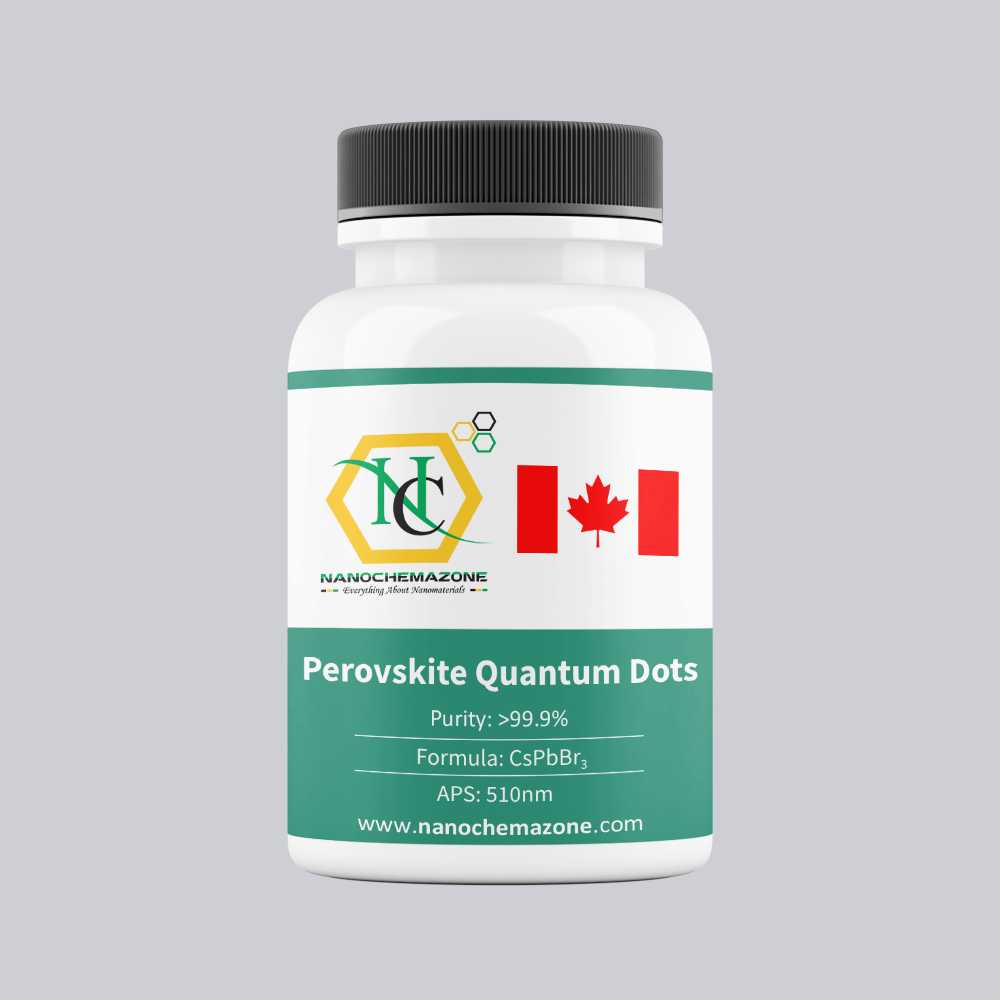
Perovskite Quantum Dots (CsPbBr3) 510 nm

Price range: $805.00 through $2,330.00
Select options This product has multiple variants. The options may be chosen on the product page
APPLICATIONS Numerous fields of application are possible for PVK quantum dots because of their electrical and optoelectronic characteristics. Uses for PVK Quantum Dots include;
  • Biosensors,
  • Bioimaging,
  • Light Emitting Diodes (LEDs),
  • Photodetectors,
  • Solar Cells,
  • Photocatalyst.

Perovskite Quantum Dots (CsPbCl3) 410 nm

Price range: $805.00 through $2,330.00
Select options This product has multiple variants. The options may be chosen on the product page
APPLICATIONS Numerous fields of application are possible for PVK quantum dots because of their electrical and optoelectronic characteristics. Uses for PVK Quantum Dots include;
  • Biosensors,
  • Bioimaging,
  • Light Emitting Diodes (LEDs),
  • Photodetectors,
  • Solar Cells,
  • Photocatalyst.

Gold (Au) Nanopowder, 20nm, ≥99.99% (4N) Purity, 1g

$805.00
Product Gold (Au) Nanopowder, 20nm, ≥99.99% (4N) Purity, 1g
CAS No. 7440-57-5
Appearance Brownish black
Purity ≥99%,  ≥99.9%,  ≥95%(Other purities are also available)
APS 20nm(Size Can be customized),  Ask for other available size range.
Ingredient Au
Molecular Weight 196.97g/mol
Melting Point N/A
Boiling Point N/A
Density 19.3g/cm³
Product Codes NCZ-356I
 

Lithium Phosphate (Li3PO4) Sputtering Targets, elastomer, Purity: 99.95%, Size: 2”, Thickness: 0.125”

$805.00

Product 

Lithium Phosphate (Li3PO4) Sputtering Targets, elastomer, Purity: 99.95%, Size: 2'', Thickness: 0.125''

CAS No.

10377-52-3

Appearance

Powder

Purity

≥99%,  ≥99.9%,  ≥95%

(Other purities are also available)

APS

 N/A (Size Can be customized), Ask for other available size ranges.

Ingredient

N/A

Molecular Weight

 115.79 g/mol

Melting Point

 ~837 °C

Boiling Point

N/A

Density

 ~2.53 g/cm³

Product Codes

NCZ-2018K

Aluminum Oxide (Al2O3) Sputtering Targets, Purity: 99.999%, Size: 3”, Thickness: 0.250”

$806.00

Product 

Aluminum Oxide (Al2O3) Sputtering Targets, Purity: 99.999%, Size: 3'', Thickness: 0.250''

CAS No.

 1344-28-1

Appearance

Powder

Purity

≥99%,  ≥99.9%,  ≥95%

(Other purities are also available)

APS

N/A (Size Can be customized), Ask for other available size ranges.

Ingredient

N/A

Molecular Weight

101.96 g/mol

Melting Point

~2,072 °C

Boiling Point

~2,977 °C

Density

~3.97–3.98 g/cm³

Product Codes

NCZ-2538K

Cerium Oxide (CeO2) Sputtering Targets, Purity: 99.99%, Size: 2”, Thickness: 0.125”

$809.00

Applications of Sputtering Targets;

Film deposition is accomplished using sputtering targets. A technique for sputtering thin films is called "deposition made by sputter targets," which entails eroding material from a "target" source onto a "substrate" like a silicon wafer. Etching of the target is done using semiconductor sputtering targets. When selectivity is not an issue and a high degree of etching anisotropy is required, sputter etching is the method of choice. By removing the target material through etching, sputter targets are also utilized for investigation. In secondary ion spectroscopy (SIMS), one example is when the target material is sputtered at a steady pace. Mass spectrometry is used to quantify the concentration and identity of spewed atoms as the target is sputtered.

The target material's composition may be ascertained and even very low concentrations of contaminants can be found with the aid of the sputtering target.

There is also an application area for sputtering targets in space. One type of space weathering that alters the chemical and physical characteristics of airless worlds like the Moon and asteroids is sputtering.

The most prevalent rare-earth element in the crust of the earth is cerium, a metal that belongs to the lanthanide series. Cerium oxide's high refractive index and dielectric constant make it suitable for a wide range of optical and electrical applications. Additionally, cerium oxide can be used for corrosion protection coatings rather than coatings based on chromate.

Lead Sulfide Quantum Dots (PbS QD) 1050 nm

Price range: $810.00 through $3,179.00
Select options This product has multiple variants. The options may be chosen on the product page

APPLICATION

Due to their distinct characteristics, PbS QDs are used in:
  • Photodetectors,
  • Light emmiting diodes (LEDs),
  • Transistors,
  • Photovoltaics,
  • Solar cells,
  • Electrocatalysis.

Bismuth Oxide (Bi2O3) Sputtering Targets, Purity: 99.9%, Size: 4”, Thickness: 0.125”

$810.00

Applications of Sputtering Targets;

Film deposition is accomplished using sputtering targets. A technique for sputtering thin films is called "deposition made by sputter targets," which entails eroding material from a "target" source onto a "substrate" like a silicon wafer. Etching of the target is done using semiconductor sputtering targets. When selectivity is not an issue and a high degree of etching anisotropy is required, sputter etching is the method of choice. By removing the target material through etching, sputter targets are also utilized for investigation. In secondary ion spectroscopy (SIMS), one example is when the target material is sputtered at a steady pace. Mass spectrometry is used to quantify the concentration and identity of spewed atoms as the target is sputtered.

The target material's composition may be ascertained and even very low concentrations of contaminants can be found with the aid of the sputtering target.

There is also an application area for sputtering targets in space. One type of space weathering that alters the chemical and physical characteristics of airless worlds like the Moon and asteroids is sputtering.

Tantalum (Ta) Sputtering Targets, Purity: 99.95%, Size: 8”, Thickness: 0.125”

$810.00

Applications of Sputtering Targets;

Film deposition is accomplished using sputtering targets. A technique for sputtering thin films is called "deposition made by sputter targets," which entails eroding material from a "target" source onto a "substrate" like a silicon wafer. Etching of the target is done using semiconductor sputtering targets. When selectivity is not an issue and a high degree of etching anisotropy is required, sputter etching is the method of choice. By removing the target material through etching, sputter targets are also utilized for investigation. In secondary ion spectroscopy (SIMS), one example is when the target material is sputtered at a steady pace. Mass spectrometry is used to quantify the concentration and identity of spewed atoms as the target is sputtered.

The target material's composition may be ascertained and even very low concentrations of contaminants can be found with the aid of the sputtering target.

There is also an application area for sputtering targets in space. One type of space weathering that alters the chemical and physical characteristics of airless worlds like the Moon and asteroids is sputtering.

Strontium Titanate (SrTiO3) Sputtering Targets, Purity: 99.9%, Size: 2”, Thickness: 0.125”

$810.00

Product 

Strontium Titanate (SrTiO3) Sputtering Targets, Purity: 99.9%, Size: 2'', Thickness: 0.125''

CAS No.

12060-08-1

Appearance

Powder

Purity

≥99%,  ≥99.9%,  ≥95%

(Other purities are also available)

APS

N/A  (Size Can be customized), Ask for other available size ranges.

Ingredient

N/A

Molecular Weight

183.49 g/mol

Melting Point

 ~2080 °C

Boiling Point

N/A

Density

~5.12 g/cm³

Product Codes

NCZ-1682K

Silicon (Si) Sputtering Targets, P-type, indium, Purity: 99.999%, Size: 4”, Thickness: 0.125”

$812.00

Product 

Silicon (Si) Sputtering Targets, P-type, indium, Purity: 99.999%, Size: 4'', Thickness: 0.125''

CAS No.

7440-21-3

Appearance

Powder

Purity

≥99%,  ≥99.9%,  ≥95%

(Other purities are also available)

APS

N/A  (Size Can be customized), Ask for other available size ranges.

Ingredient

N/A

Molecular Weight

28.0855 g/mol

Melting Point

 1,414 °C

Boiling Point

3,265 °C

Density

 2.33 g/cm³

Product Codes

NCZ-1738K

Silicon Carbide Wafer (SiC-4H) – 4H, Size: 2”, Thickness: 350 μm, Production Grade, 4H Area: 1

Price range: $813.00 through $3,571.00
Select options This product has multiple variants. The options may be chosen on the product page
Silicon Carbide Wafer (SiC-4H) – 4H Size: 2”, Thickness: 350 μm, 4H Area: 1 Technical Properties: Quality  Production Grade Size (inch)  2”

Gallium Antimonide (GaSb) Wafers, Size: 3”, Thickness: 625± 25 μm, Orientation: 111, Testing Grade

Price range: $813.00 through $3,801.00
Select options This product has multiple variants. The options may be chosen on the product page
Gallium Antimonide (GaSb) Wafers Size: 3”, Thickness: 625± 25 μm, Orientation: 111 Technical Properties: Quality  Testing Grade Size (inch)  3” Thickness

Gallium Antimonide (GaSb) Wafers, Size: 3”, Thickness: 625± 25 μm, Orientation: 100, Testing Grade

Price range: $813.00 through $3,801.00
Select options This product has multiple variants. The options may be chosen on the product page
Gallium Antimonide (GaSb) Wafers Size: 3”, Thickness: 625± 25 μm, Orientation: 111 Technical Properties: Quality  Testing Grade Size (inch)  3” Thickness

Titanium Nitride (TiN) Sputtering Targets, Purity: 99.5%, Size: 3”, Thickness: 0.250”

$814.00

Applications of Sputtering Targets;

Film deposition is accomplished using sputtering targets. A technique for sputtering thin films is called "deposition made by sputter targets," which entails eroding material from a "target" source onto a "substrate" like a silicon wafer. Etching of the target is done using semiconductor sputtering targets. When etching anisotropy is high, sputter etching is the preferred method.

is required, and selectivity is unimportant. By removing the target material through etching, sputter targets are also utilized for investigation. In secondary ion spectroscopy (SIMS), one example is when the target material is sputtered at a steady pace. Mass spectrometry is used to quantify the concentration and identity of spewed atoms as the target is sputtered.

The target material's composition may be ascertained and even very low concentrations of contaminants can be found with the aid of the sputtering target.

There is also an application area for sputtering targets in space. One type of space weathering that alters the chemical and physical characteristics of airless worlds like the Moon and asteroids is sputtering.

Titanium Carbide (TiC) Sputtering Targets, Purity: 99.5%, Size: 3”, Thickness: 0.125”

$815.00

Product 

Titanium Carbide (TiC) Sputtering Targets, Purity: 99.5%, Size: 3'', Thickness: 0.125''

CAS No.

 12070-08-5

Appearance

Powder

Purity

≥99%,  ≥99.9%,  ≥95%

(Other purities are also available)

APS

N/A  (Size Can be customized), Ask for other available size ranges.

Ingredient

N/A

Molecular Weight

59.89 g/mol

Melting Point

 ~3160 °C

Boiling Point

N/A

Density

4.93 g/cm³

Product Codes

NCZ-1610K

Microwave-Alkali extraction, Molecular weight 10000-20000g/mol, Ash ≤0.05%, Lignin ≤0.8%

$815.00
Select options This product has multiple variants. The options may be chosen on the product page

Product 

Microwave-Alkali extraction, Molecular weight 10000-20000g/mol, Ash ≤0.05%, Lignin ≤0.8%

CAS No.

 Generic for cellulose: 9004-34-6

Appearance

Powder

Purity

≥99%,  ≥99.9%,  ≥95%

(Other purities are also available)

APS

 ~10 – 50 nm (Size Can be customized), Ask for other available size ranges.

Ingredient

N/A

Molecular Weight

 8,000 – 20,000 g/mol

Melting Point

N/A

Boiling Point

N/A

Density

~1.5 – 1.6 g/cm³

Product Codes

NCZ-2600K

Hemicellulose(from Bamboo) (453510)

$815.00
Select options This product has multiple variants. The options may be chosen on the product page

Product 

Hemicellulose(from Bamboo) (453510)

CAS No.

No match for "453510"—no recognized CAS number for bamboo hemicellulose

Appearance

Powder

Purity

≥99%,  ≥99.9%,  ≥95%

(Other purities are also available)

APS

  N/A(Size Can be customized), Ask for other available size ranges.

Ingredient

N/A

Molecular Weight

 BSH‑1: ~12.8 kDa; BSH‑2: ~11.3 kDa; Other methods: up to ~35–44 kDa

Melting Point

N/A

Boiling Point

N/A

Density

~1.52 g/cm³ (experimental); ~1.45 g/cm³ (simulation)

Product Codes

NCZ-2653K

Lithium Niobate (LiNbO3) Sputtering Targets, Purity: 99.9%, Size: 1”, Thickness: 0.250”

$816.00

Applications of Sputtering Targets;

Film deposition is accomplished using sputtering targets. A technique for sputtering thin films is called "deposition made by sputter targets," which entails eroding material from a "target" source onto a "substrate" like a silicon wafer. Etching of the target is done using semiconductor sputtering targets. When selectivity is not an issue and a high degree of etching anisotropy is required, sputter etching is the method of choice. By removing the target material through etching, sputter targets are also utilized for investigation. In secondary ion spectroscopy (SIMS), one example is when the target material is sputtered at a steady pace. Mass spectrometry is used to quantify the concentration and identity of spewed atoms as the target is sputtered.

By helping of the sputtering target, the composition of the target material may be evaluated and even extremely tiny amounts of contaminants are recognized.

There is also an application area for sputtering targets in space. One type of space weathering that alters the chemical and physical characteristics of airless worlds like the Moon and asteroids is sputtering.

4N (99.99%) Aluminum Fluoride (AlF3) Pieces (1-10mm ) Evaporation Materials

$816.00
Select options This product has multiple variants. The options may be chosen on the product page
Product 4N (99.99%) Aluminum Fluoride (AlF3) Pieces (1-10mm ) Evaporation Materials
CAS No. 7784-18-1
Appearance Colorless, White solid
Purity ≥99%,  ≥99.9%,  ≥95%(Other purities are also available)
APS 1-10mm (Size Can be customized),  Ask for other available size range.
Ingredient AlF3
Molecular Weight 83.98 g/mol
Melting Point 1290 °C
Boiling Point N/A
Density 3.1 g/cm³
Product Codes NCZ-140E
 

Lanthanum Calcium Manganate (La0.7Ca0.3MnO3) Sputtering Targets, Purity: 99.9%, Size: 7”, Thickness: 0.125”

$816.00

Product 

Lanthanum Calcium Manganate (La0.7Ca0.3MnO3) Sputtering Targets, Purity: 99.9%, Size: 7'', Thickness: 0.125''

CAS No.

123273‑09‑6

Appearance

Powder

Purity

≥99%,  ≥99.9%,  ≥95%

(Other purities are also available)

APS

 N/A (Size Can be customized), Ask for other available size ranges.

Ingredient

N/A

Molecular Weight

 ~313.9 g/mol

Melting Point

 ~1,550 °C (approximate; ceramic decomposition likely above)

Boiling Point

N/A

Density

 ~5.3 g/cm³ @ room temp

Product Codes

NCZ-2146K

Lanthanum Strontium Manganate (La0.7Sr0.3MnO3) Sputtering Targets, Purity: 99.9%, Size: 2”, Thickness: 0.125”

$817.00

Applications of Sputtering Targets;

  • Sputtering targets is used for film deposition. The deposition made by sputter targets is a method of depositing thin films by sputtering that involves eroding material from a "target" source onto a "substrate" such as  a silicon wafer.
  • Semiconductor sputtering targets is used to etch the target. Sputter etching is chosen in cases where a high degree of etching anisotropy is needed and selectivity is not a concern.
  • Sputter targets is also used for analysis by etching away the target material.
One of the example occurs in secondary ion spectroscopy (SIMS), where the target sample is sputtered at a constant rate. As the target is sputtered, the concentration and identity of sputtered atoms are measured using mass spectrometry. By helping of the sputtering target, the composition of the target material can be determined and even extremely low concentrations of impurities are detected. Sputtering target has also application area in space. Sputtering is one of the forms of space weathering, a process that changes the physical and chemical properties of airless bodies, such as asteroids and the Moon.

Titanium Dioxide (TiO2) Sputtering Targets, Purity: 99.99%, Size: 1”, Thickness: 0.250”, Beige to White

$817.00

Product 

Titanium Dioxide (TiO2) Sputtering Targets, Purity: 99.99%, Size: 1'', Thickness: 0.250'', Beige to White

CAS No.

13463‑67‑7

Appearance

Powder

Purity

≥99%,  ≥99.9%,  ≥95%

(Other purities are also available)

APS

TiO₂ (black granules) (Size Can be customized), Ask for other available size ranges.

Ingredient

N/A

Molecular Weight

79.94 g/mol

Melting Point

~1,843 °C

Boiling Point

~2,972 °C

Density

~4.23 g/cm³

Product Codes

NCZ-1442K

Titanium Carbide (TiC) Sputtering Targets, Purity: 99.5%, Size: 4”, Thickness: 0.250”

$818.00

Applications of Sputtering Targets;

Film deposition is accomplished using sputtering targets. A technique for sputtering thin films is called "deposition made by sputter targets," which entails eroding material from a "target" source onto a "substrate" like a silicon wafer. Etching of the target is done using semiconductor sputtering targets. When selectivity is not an issue and a high degree of etching anisotropy is required, sputter etching is the method of choice. By removing the target material through etching, sputter targets are also utilized for investigation. In secondary ion spectroscopy (SIMS), one example is when the target material is sputtered at a steady pace. Mass spectrometry is used to quantify the concentration and identity of spewed atoms as the target is sputtered.

The target material's composition may be ascertained and even very low concentrations of contaminants can be found with the aid of the sputtering target.

There is also an application area for sputtering targets in space. One type of space weathering that alters the chemical and physical characteristics of airless worlds like the Moon and asteroids is sputtering.

Lead Sulfide Quantum Dots (PbS QD) 950 nm

Price range: $820.00 through $3,245.00
Select options This product has multiple variants. The options may be chosen on the product page

APPLICATION

Due to their distinct characteristics, PbS QDs are used in:
  • Photodetectors,
  • Light emmiting diodes (LEDs),
  • Transistors,
  • Photovoltaics,
  • Solar cells,
  • Electrocatalysis.

Activated carbon fiber Felt(Rayon based, high surface area) (264584)

Price range: $820.00 through $1,345.00
Select options This product has multiple variants. The options may be chosen on the product page
Activated carbon fiber Felt(Rayon based, high surface area) (264584)
Grade Surface area(m2/g) Weight(g/m2) Width(m) Thickness(mm) Price($/kg)
1800 1800 250 1 3-3.5 820
2000 2000 250 1 3-3.5 1345
Product Codes- NCZ-2689K

Chromium (Cr) Sputtering Targets, Purity: 99.95%, Size: 8”, Thickness: 0.125”

$821.00

Product 

Chromium (Cr) Sputtering Targets, Purity: 99.95%, Size: 8'', Thickness: 0.125''

CAS No.

7440‑47‑3

Appearance

Powder

Purity

≥99%,  ≥99.9%,  ≥95%

(Other purities are also available)

APS

 N/A (Size Can be customized), Ask for other available size ranges.

Ingredient

N/A

Molecular Weight

 51.9961 g/mol

Melting Point

 1,857 °C

Boiling Point

 2,672 °C

Density

 7.14 g/cm³

Product Codes

NCZ-2308K

Indium Phosphide (InP) Wafers, Size: 3”, Thickness: 600± 25 μm, Orientation: 111 , Single Side Polished, EPI-Ready, Dopant: Iron (N Type)

Price range: $822.00 through $3,936.00
Select options This product has multiple variants. The options may be chosen on the product page
Indium Phosphide (InP) Wafers Size: 3”, Thickness: 600± 25 μm, Orientation: 111 Technical Properties: Size (inch)  3” Thickness (μm)  600±

Indium Phosphide (InP) Wafers, Size: 3”, Thickness: 600± 25 μm, Orientation: 100, Single Side Polished, EPI-Ready, Dopant: Iron (N Type)

Price range: $822.00 through $3,936.00
Select options This product has multiple variants. The options may be chosen on the product page
Indium Phosphide (InP) Wafers Size: 3”, Thickness: 600± 25 μm, Orientation: 100 Technical Properties: Size (inch)  3” Thickness (μm)  600±

Titanium Dioxide (TiO2) Sputtering Targets, indium, Purity: 99.99%, Size: 1”, Thickness: 0.125”, Beige to White

$823.00

Applications of Sputtering Targets;

Film deposition is accomplished using sputtering targets. A technique for sputtering thin films is called "deposition made by sputter targets," which entails eroding material from a "target" source onto a "substrate" like a silicon wafer. Etching of the target is done using semiconductor sputtering targets. When selectivity is not an issue and a high degree of etching anisotropy is required, sputter etching is the method of choice. By removing the target material through etching, sputter targets are also utilized for investigation. In secondary ion spectroscopy (SIMS), one example is when the target material is sputtered at a steady pace. Mass spectrometry is used to quantify the concentration and identity of spewed atoms as the target is sputtered.

The target material's composition may be ascertained and even very low concentrations of contaminants can be found with the aid of the sputtering target.

There is also an application area for sputtering targets in space. One type of space weathering that alters the chemical and physical characteristics of airless worlds like the Moon and asteroids is sputtering.

Lead Sulfide Quantum Dots (PbS QD) 850 nm

Price range: $825.00 through $3,299.00
Select options This product has multiple variants. The options may be chosen on the product page

APPLICATION

Due to their distinct characteristics, PbS QDs are used in:
  • Photodetectors,
  • Light emmiting diodes (LEDs),
  • Transistors,
  • Photovoltaics,
  • Solar cells,
  • Electrocatalysis.

Vanadium Carbide (V2C) MXene Multilayer Flakes

$825.00
Select options This product has multiple variants. The options may be chosen on the product page
Product Vanadium Carbide (V2C) MXene Multilayer Flakes
CAS No. 12179-42-9
Appearance Dark gray to black
Purity ≥99%,  ≥99.9%,  ≥95%(Other purities are also available)
APS 100nm (Size Can be customized),  Ask for other available size range.
Ingredient V2C
Molecular Weight 108.9 g/mol
Melting Point N/A
Boiling Point N/A
Density 6.0 g/cm³
Product Codes NCZ-594I
 

Cerium Oxide (CeO2) Sputtering Targets, Purity: 99.99%, Size: 1”, Thickness: 0.125”

$826.00

Applications of Sputtering Targets;

Film deposition is accomplished using sputtering targets. A technique for sputtering thin films is called "deposition made by sputter targets," which entails eroding material from a "target" source onto a "substrate" like a silicon wafer. Etching of the target is done using semiconductor sputtering targets. When selectivity is not an issue and a high degree of etching anisotropy is required, sputter etching is the method of choice. By removing the target material through etching, sputter targets are also utilized for investigation. In secondary ion spectroscopy (SIMS), one example is when the target material is sputtered at a steady pace. Mass spectrometry is used to quantify the concentration and identity of spewed atoms as the target is sputtered.

The target material's composition may be ascertained and even very low concentrations of contaminants can be found with the aid of the sputtering target.

There is also an application area for sputtering targets in space. One type of space weathering that alters the chemical and physical characteristics of airless worlds like the Moon and asteroids is sputtering.

The most prevalent rare-earth element in the crust of the earth is cerium, a metal that belongs to the lanthanide series. Cerium oxide's high refractive index and dielectric constant make it suitable for a wide range of optical and electrical applications. Additionally, cerium oxide can be used for corrosion protection coatings rather than coatings based on chromate.

Silicon Carbide Wafer (SiC-4H) – 4H, Size: 4”, Thickness: 350 μm, Testing Grade, 4H Area: 95%

Price range: $827.00 through $4,069.00
Select options This product has multiple variants. The options may be chosen on the product page
1 piece/750 € 5 pieces/3690 €                 Please contact us for quotes on larger quantities !!!

Silicon Carbide Wafer (SiC-4H)- 4H

Size: 4'', Thickness: 350 μm, 4H Area: 95%

Technical Properties:

Quality  Testing Grade
Size (inch)  4”
Thickness (μm)  350
Ra  ≤0.3
4H area  95%
Orientation  4°±0.5°
Resistivity   0.015-0.03
TTV  ≤25
Bow  ≤30
Warp  ≤35
OF Length  32.5±2
IF Length  18±2

Fields of Application for Silicon Carbide (SiC-4H) - 4H Wafer

Silicon carbide (SiC) is a rare compound of silicon and carbon which is synthetically produced. Silicon carbide (SiC) wafer has great electrical properties and excellent thermal properties. Silicon carbide (SiC) wafer has low thermal expansion. Silicon carbide (SiC) wafer has superior hardness properties. Silicon carbide (SiC) wafer performs well at high temperatures. Also, silicon carbide (SiC) wafer has high resistance to corrosion, erosion and oxidation. In addition to, silicon carbide (SiC) wafer is also more shiny than either diamonds or cubic zirconia. Silicon carbide (SiC) crystals have unique physical and electronic properties. Silicon Carbide based devices have been used for short wavelength opto-electronic, high temperature, radiation resistant applications.  The high-power and high-frequency electronic devices made with SiC are superior to Si and GaAs based devices.  Below are some popular applications of SiC substrates. SiC based devices have low lattice mismatch with III-nitride epitaxial layers.  They have high thermal conductivity and can be used for the monitoring of combustion processes and for all sorts of UV-detection.  SiC-based semiconductor devices can work under very hostile environments, such as high temperature, high power, and high radiation conditions. SiC is used for the fabrication of very high-voltage and high-power devices such as diodes, power transistors, and high power microwave devices. Compared to conventional Si-devices, SiC-based power devices have faster switching speed higher voltages, lower parasitic resistances, smaller size, less cooling required due to high-temperature capability. While Silicon carbide (SiC-4H) - 4H wafer has superior electronic properties, silicon carbide (SiC-6H) – 6H wafer is most easily prepared and best studied.
  • Silicon carbide (SiC) wafer is used for hybrid and electric vehicles.
  • Silicon carbide (SiC) wafer is used for green energy generation.
  • Silicon carbide (SiC) wafer is used for LEDs.
  • Silicon carbide (SiC) wafer is used for many other emerging markets.

Cobalt (Co) Sputtering Targets, Purity: 99.95%, Size: 6”, Thickness: 0.250”

$827.00

Product 

Cobalt (Co) Sputtering Targets, Purity: 99.95%, Size: 6'', Thickness: 0.250''

CAS No.

7440‑48‑4

Appearance

Powder

Purity

≥99%,  ≥99.9%,  ≥95%

(Other purities are also available)

APS

 N/A (Size Can be customized), Ask for other available size ranges.

Ingredient

N/A

Molecular Weight

58.93 g/mol (cobalt atomic weight)

Melting Point

~1,495 °C

Boiling Point

~2,870–2,927 °C

Density

~8.9 g/cm³

Product Codes

NCZ-2287K

Indium Phosphide (InP) Wafers, Size: 4”, Thickness: 625± 25 μm, Orientation: 111, Single Side Polished, Testing Grade

Price range: $828.00 through $3,816.00
Select options This product has multiple variants. The options may be chosen on the product page
Indium Phosphide (InP) Wafers Size: 4”, Thickness: 625± 25 μm, Orientation: 111 Technical Properties: Size (inch) 4” Thickness (μm) 625±

Indium Phosphide (InP) Wafers, Size: 4”, Thickness: 625± 25 μm, Orientation: 100, Single Side Polished, Testing Grade

Price range: $828.00 through $3,816.00
Select options This product has multiple variants. The options may be chosen on the product page
Indium Phosphide (InP) Wafers Size: 4”, Thickness: 625± 25 μm, Orientation: 100 Technical Properties: Size (inch)  4” Thickness (μm)  625±